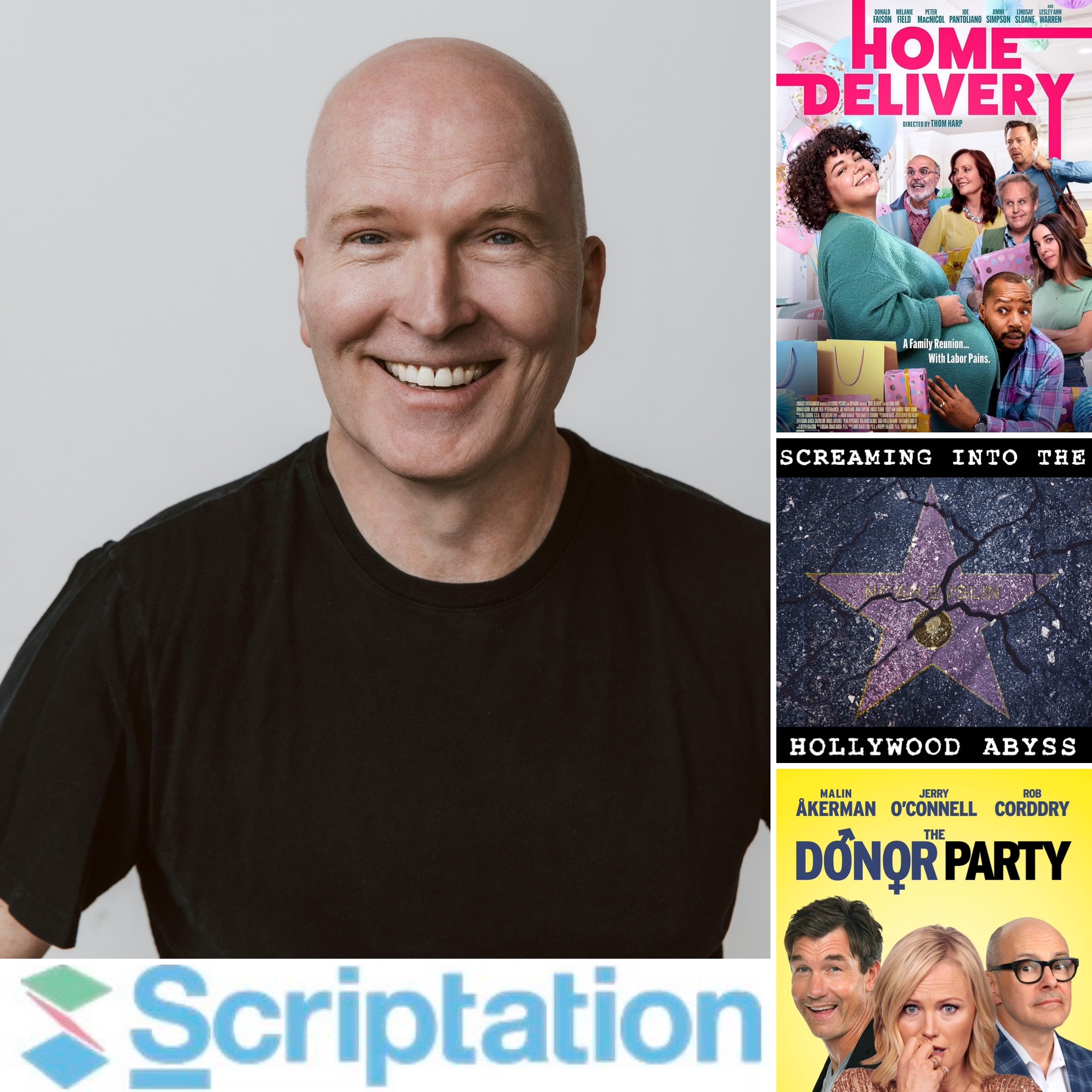
Take 152 - Writer, producer, director Thom Harp, Home Delivery, The Donor Party

 Apple Podcasts
 Spotify
 Podchaser
 RSS Feed
 What a nice man!
We have Thom Harp on the show to talk movies, pitches and being nice.
We talk persistence, writing what you know and getting the best out of your team.
Thom describes the frustrations of years of pushing, how he made the most of the Covid opportunity by listening to sensible advice and the joy of working in a job you love.
A really fun, informative and engaging chat.
Any of us who've been in it for long enough, our entire career has been littered with jobs that we didn't get, projects that we thought were gonna go for shore, dozens of unproduced scripts littering the floor.
SPEAKER_03All of us are running into both major and minor failures in Hollywood every single day.
SPEAKER_02For every success, there is months, sometimes even years, of painful failure.
SPEAKER_03This is one of the only businesses I can think of where failure is the default. That's the norm. You have to be able to persevere. That process takes that doesn't happen overnight.
SPEAKER_01I was being told by my manager it's yours to lose, and I promptly lost it. And I remember thinking like, well, that's it for me. I blew my one big shot. What I've realized from that moment is it's never one big shot. There will be other shots.
SPEAKER_02Welcome back to Screaming Into the Hollywood Abyss, a podcast about rejection, failure, and adversity in the entertainment industry, brought to you by the Emmy Award-winning annotation software Scriptation. As ever, I am Dan Rutstein, your non-entertainment co-host.
SPEAKER_04And I'm your still in the entertainment industry co-host, Noah Epsilon. On today's Screaming Into the Hollywood Abyss, I'm thrilled to introduce screenwriter and director and producer Tom Harp to the podcast. He's written and directed such films as Home Delivery and The Donor Party, as well as the podcast Dark Air with Terry Carnation, amongst others. Welcome, Tom. Thank you guys so much for having me.
SPEAKER_02Uh let's do this for a first question. So you are a regular listener, so thank you very much for being a regular listener. Why did you choose to come on our podcast, given that we're probably not going to be asking you about all your successes?
SPEAKER_00I think that one of the things that's that's so helpful to writers, especially, is to know what the what the paths are that people have taken. Because I think there's a lot of it's a dream factory, you know. Hollywood is a dream factory. And and one of the things that I don't think happens that much anymore, but certainly when I was starting was the the illusion or the uh the myth of the million dollar sale that would suddenly like change everything. And I think it's really important for people to kind of understand what it means to be an in, you know, in the trenches writer. Um and what that you know what that what years of of pushing the the uh rock up the hill actually looks like I think that's a that's an excellent answer.
SPEAKER_02So what is pushing the rock up the hill for years actually like? What what has it been like for you? Um and how many times has you have you actually slipped and the rocks run over you and fallen to the bottom and you start it again, or nearly slipped?
SPEAKER_00I think virtually every project I've tried to get off the ground has had multiple times where the rock has has bowled me back over. And one of the reasons why the two movies that I've had produced were things that I directed is because I was so frustrated at getting optioned and stuff never getting made. So I would have lots and lots of uh things optioned. I, you know, was I remember getting a thing from my agent like, you're in the hot list or whatever the thing was. And I was like, great, when is it gonna sell? Oh, it probably won't. Um, you know, that whole idea of, you know, you meet, I think that one of the th one of the big things that's important for writers to know is that the most important thing that you can do is keep generating new material because the new material will be the thing that will get you in a room that will hopefully lead to you getting hired to do something that they own the IP for. Um that's a horrible, horrible way to plan a career as a as a creative person. But at the same time, it's just really important to know that. Um, and for me, you know, having years of not being able to get anything off the ground meant that I was um the only way that I was going to be able to do it was by writing something that was producible enough at a low budget that you know that I could hold it hostage and say, if you like this, I want to be the director. And fortunately, I've written it so that it will be something manageable and your risk will be low.
SPEAKER_04So I've I've known you for a while. We've met this is the first time we're meeting virtually, but I've I mean we've known each other on social media, I would say eight, ten years, many, many years. Uh I've noticed looking at your credits that you've you've been pushing that rock up the hill for a long time. I mean, we all have. There's not a single person working in Hollywood who hasn't been pushing that rock up the hill, but you you you've been you know steadily going at it for 25 years, I would say. And then in the hardest period of Hollywood's history, I think we've had a lot of guests on who would agree that the last few years, there's been nothing like the last few years. Suddenly you knock out two movies. So I I'm cu and with with real cast, with with real releases, so I'm curious about how did you get the first one off the ground in this sort of like the nuts and bolts of it in the sort of crazy business? How did you it's not like you just decided one day, or maybe you did. I'm making this movie and started to make a movie. Obviously, the financing, how did it all come how did it all come together?
SPEAKER_00Well, I need to rewind a little bit in order to give the proper context. So I had a um I had a script that was that I had a writing partner, and um we met up in Seattle. This is when I was living in Seattle, and I had been in Seattle a cinematographer, and I'd come up at the same time as Lynn Shelton. And Lynn Shelton was an editor for hire, and I was a cinematographer for hire, and we became friends. We have kids the same age. Um, and so she, you know, when I uh made one of my short films with Sandra O, she was the editor on it. I asked her to edit it. And when she was making one of her first short films, actually, her first two short films, she asked me to shoot it for her. And so we we had the sense of like, oh, things, big things are happening. And I had this script that got, you know, set up at Paramount and it was, and I thought it was exciting, and you know, this was gonna be the thing that changed everything. And my wife was out of med school and ready to, you know, like, okay, now we're portable. We have a young family, they're not so old that they're gonna, it's gonna screw them up to move to a new city. Moved to LA and another movie at Paramount that was a teen comedy, which is what mine was, bombed. And so they pulled the plug on mine. And so I had just moved my family. I had you know, my writing partner through this process got really disillusioned by the industry. So he decided he didn't want to do anything anymore. The manager didn't like the next thing that that uh I wrote on my own. She's like, Well, you we had sent you out as a team, and now you're a solo writer. I don't know what to do with you. So I had no manager, I had no um writing partner and and no real prospects. And and that was, and I had just moved my family to to Los Angeles with nothing, basically. So that was a really sobering moment. And um out of that, at the same time as that was happening, Lynn Shelton's career was taking off. And she had done uh two very small movies uh that were done for like less than 50 grand each, and then she made Hump Day, which played it South by Southwest, got a lot of attention, got bought, was had a good release, was with Mark Duplas. The two of them were kind of taking off at the same time. And I was like, wait, and it's not, I mean that there was probably some professional jealousy, but it was also more like, how did you do that? Like, what was the thing that you did to get that to happen? And so while I was writing stuff that I was hoping would sell, I talked to her and I said, Well, what are your what is the formula basically? And her she broke it down really simply. She said, You want to limit the screen time. And I and I don't mean like the length of the film, I mean like the the duration of the film so that it only goes over like a very limited amount of days because then you don't have a lot of costume changes. Um, costume changes suck time away from the production. You know, you're sending people offset, they go through costume and wardrobe and all that stuff. You lose time there. Um, she said you you want to stay in one location per day because every time you move location, you're you're really killing yourself. So have scenes that, you know, have longer scenes that all take place in a in one location. Um, and then she's like, and ideally have that location for a lot of the film so that you can just leave everything because at the then the next morning you can get your first shot in you know, 45 minutes after you arrive. And then the most important piece of advice was she said, lean into your strengths. And that's the one that I think is the most useful for every writer to think of, because she said, your strength, Tom, is that you love comedy and you write dialogue, great dialogue, and you love working with lots of different voices, like you have an ensemble vibe. So do something like that. And out of that, I was thinking back on what were the experiences where, because one of the things that I hate in contained movies that is that they feel cheap. They feel like they're only in one location because that's all they could afford. So my goal was how do I create something where it's justified that you're there, that you're stuck in this location? I think Green Room, which is a thriller, um, does a great job of this. The whole thing takes place in a club and they're stuck there and they can't get out. Perfect. Um, so I wanted, so once I had all those things, I thought, okay, well, I can write a story about, you know, I have three kids and I can write a story that incorporates kind of some of the aspects of the births of my kids and also some of the funny stories that people have shared with me and some heartfelt stuff that I really wanted to, you know, that there's something in in the end of uh home delivery that it gets kind of dark. And I knew that if I sort of with the James Brooks attitude of like you get people to laugh and then they start, and then you can get deeper as it goes into this, you know, deep into the second act and into the third act. Um, so I just I I thought, how can I be very, very smart about my limitations? And that script ended up getting a lot, it was home delivery, ended up getting a lot of attention. And they set it up at um, we were able to get it set up at Voltage, uh, which is a great, you know, in indie releasing company, distributor production company. Uh, but I was the problem because I hadn't directed enough. So I had meetings with actors, but they didn't want me to direct it. So that was, you know, I'd written something that they were excited because it was cheap and they could they knew they could get it done, but I was the boat anchor that was dragging it along. So again, like that rolled up the hill. They optioned it twice trying to get it made. So that was three years that they put a lot of energy into it. Um, and it just we couldn't get it to happen because of me, not because of their work at all. So those are the sobering stories that I think it's really important for people to hear. And as we were getting those that feedback, I was like, I have to start directing some stuff so that people feel more comfortable with me directing. So that's when I got involved with Funnier Die and started doing shorts for them. And that slowly began to change people's vibe, and they they got more like, oh, I maybe I can trust him.
SPEAKER_04So and at one point in here, because I'm just trying to put the pieces of the story together, you you you started off saying, I lost my manager, I lost my team, I I lost my writing partner. I'm I'm basically below ground zero, but living in LA. But then at some point, obviously, you know, in this history, and I'm not sure how many years because you didn't give me a year for it, you you put a team back together, some people started believing you again. Like, how did that like like you know, you you obviously were able to hit the ground with some momentum when you got to voltage?
SPEAKER_00So, okay. That's so thank you, Noah, for for doing that. That's a really uh that's a bad omission, I apologize. Um so what happened is as we as happens with every good script, you know, the fact that it got set up at a studio, um, I did the water bottle tour of a lot of different places, and people were excited to meet, you know, someone who's got a little bit of heat on them. So when I had my next, and at the same time that this was all falling apart, the blacklist debuted their um, you know, their online version. And people could submit scripts to the blacklist and get them available, you know, pay for evaluations, and then you you could see what kind of momentum would happen. Well, the script that my manager said, This is horrible, I can't sell it. You and literally told my writing partner, you have to get him to not send this anywhere because it will kill your careers. Um, was a comedy about the devil. And it got nines on the blacklist live. So I went, as soon as I got that, I knew that the script was not gonna necessarily sell because it's a very expensive, you know, it's it's like a high budget comedy. Um, but I went back to all the people who I'd had meetings with, and the you know, during that water bottle tour, and they uh and I said, Hey, look, I've got a new script. It's getting nine, it got two nines on the blacklist, which was kind of unheard of at the time. Um would love to send it to you. And I got a couple really nice, like congratulation things back, but one producer really had remembered you know meeting me and and my writing partner and liked us and and and was like, well, what else do you have that that could be the next thing? And I pitched this idea and she was like, I'd love to work on that with you. And so we developed this. Um, it was called Drunk Dial. And that we uh once it was ready to go, we um I said, we probably need to get an agent on board. So I met with a couple different agencies and I liked the folks at Gersh, who which is where I signed. Um, and that's how the team came back together. So that so then when I had home delivery, the first draft of home delivery, it was it was basically right after I had signed at Gersh. And I um said, listen, this is one that's not really for sale, it's for that I really want to direct. And they sent it to their indie film guy, and he read it and fell in love with it. He read it on the way back from a telluride that he said was the most depressing telluride he'd ever been to. You know, it was just like horrible movie after horrible movie after horrible movie and unfunny. And and he was so relieved to have something fun that you know he was reading and he got behind it. And that, and he's the one who set it up at voltage. So hopefully that, you know, again, that was the the thing of you just have to hustle. And and you know, I was I'm thrilled that I had a script that got the that gave me another jolt, you know, that I could, you know, that I could screenshot and send to people so they could see, like, I'm not lying about the nines, here they are, and uh, and then you know, from that, and it was all again, all it takes is that one yes.
SPEAKER_02So um we've been on with you for whatever it is, 15 minutes and about five minutes of pre-chat, and uh and I don't say this to many guests, but you seem you seem quite nice as a person, um and not everyone is, um uh, but in today's world, I guess how much time do you spend bothering people to get what you need, and how much do your people do it for you? Because I think we've had some very nice people on here who were Canadian. Um I think it might be a coincidence, but also they were very nice. But they were it, you know, they were they produced big things. I got the sense that probably someone's going around sort of getting them all their meetings and doing all this stuff. But the way you've had to do yours is you say you've it feels like you've been pushing the rock yourself quite a lot, as well as having your reps do it for you. So are you are you not that nice when you're sort of knocking on everyone's door four times and not taking no for an answer? And how does niceness play into the persistence that you need to make it?
SPEAKER_00I for me, it's the only way that I work. Um and and here's the thing I have kids and I've been, you know, and I was the stay-at-home caregiver. And I've one of the things that I had to do very early on is like explain to all the moms on the playground, like that kid over there, that's the blonde one, that one belongs to me. I'm not this creep here, like lurking, uh, you know, and so I've I've had to put myself out there into areas that it's not like it. I just so I lead with kindness. Um, and one of the things that that because I'm not young, uh, that I I didn't get to make a movie like a couple years out of film school, you know, I was uh I like I said, I was a cinematographer first, and then really working hard, you know, and then when we had kids, which was pretty young, I was the one who stayed at home to raise the kids. And uh while my wife was in med school and then residency and all that kind of stuff. So I only wrote during their nap times. And, you know, when I had a writing partner, I we would write on the weekends or at night. Um, and it was it was tough. So for me, the whole thing is I just have I operate with a lot of gratitude. Like I'm very grateful for the opportunities that I have, but I've also made the opportunities. So the very first thing that I got to direct um after graduating from film school was a trailer for the Seattle lesbian and gay film festival. And I I saw I was an open call, and I thought, I have this really funny idea for a spin the bottle thing that would end up being like two people of the same gender would get each other, and like one of them's like, uh, everyone, everyone thinks, oh, that's not okay. And then the girl who spun the bottle was like, no, no, it's fine. And you know, we get that as the end of it. And I thought that's a sweet kind of John Hughesy kind of way of looking at something. And it was a huge hit to have, you know, people cheered for that trailer. The next thing that the next short film that I did, I, you know, I was asked to teach a class and they said, here's the, you know, we're doing it on film, and you know, we know you have a background as a as a DP. I said, Well, why don't we turn it into a short film? Knowing that I was going to that if I could make a film with two roles of Super 16 film, then I would be able to get a short film out of it. So I tailored everything to make sure that the story was short enough that we could pull it off and and do this whole thing. So I turned the class into the a way to make my short film. Um, and so I had to, all of those things were ways that I that I hustled. And when I went out to to um funnier die, the same thing. I just pitched ideas and I had so many ideas, and they were like, okay, these are good ones, and so make one of them. And so I, you know, I put a little bit of money of my own into it, and then you sort of get some money back on the it just it was always believing in myself and pitching myself really hard. But in terms of being nice, for me, that patience that I had to do that I had to develop as a writer, you know, and the thick skin of of hearing knows and and having to believe in yourself beyond the no is where when you do get the opportunity, you're unless you're a jerk, uh you know, you can't help but be grateful. I mean, it it took 10 years from the I from the script to it coming out for home delivery to happen. I mean, 10 years of waiting. And I didn't get bitter about it once. You know, we had I've had three different producers on it. And the last one was able to make it happen because, no, as you mentioned, uh, it was it was during the, you know, the pandemic was happening. They were looking for stuff that could get made. That would be cheap and would be, you know, so all the financing started to come together under those circumstances. It was very much like, how can we? And this guy who read it read it, you know, before when it was set up to be a more expensive movie and thought, oh, well, I can make it for this budget, and it'll be my first producing credit. So everyone, you know, like again, it was finding a way to get a story told on a certain size budget, and then being really adamant about I wanted to direct it myself, knowing that that was the way that I could make sure that for better or for worse, if you like it or if you don't, it's the thing that I wanted to get out there. And that, you know, having had other things fall to the wayside because you know, someone else got hired to do a rewrite on it, that's fine. You know, you get paid, that's great. Um, but it again, I just wanted it to get made. Um, and made the way that it would be a good representation of what I can do. So um does that answer the question? I'm not, I think I didn't 100%.
SPEAKER_02Okay. Um, so look, I I would never be so bold as to intrude into somebody else's marriage, however, um having one person in the marriage is saving lives, changing lives, dealing with people with um you know, real real life problems, um, and then the other one's writing comedy. Um, how is that is that is that good? Is that does that do you help each other? What's the dynamic like over the dinner table?
SPEAKER_00It's you know, I think that for her, it is the thing that keeps her sane. So I feel very, you know, and she's saving lives, and you know, and when whenever she so when we were in, a good example is when we were in um her intern year, which is the worst time, it's when you you basically are on for three days, like you have 48 to to 72 hours where you're on straight and you can take little naps, but you're at the hospital, and then you're off for the for the same amount of time. I would we had a a baby, and I had to go to the hospital. She would go to the nurse's room, pump, and then I would have to go pick up the milk that she had just pumped. And you know, we we were doing this thing. So I lived a we lived in a small place a block away from the hospital, so we could do that. And it was I my for me, all those memories are joyful memories because it was, you know, we were we were a team and we we were making it happen, and and it was something that now we get to be on the other side. Our kids are mostly, you know, like they can even drive themselves everywhere. So at this point, you know, we're much it's now we're like, oh, we wanted to have everyone together for a movie night or whatever, but it's you know, they're they're busy and they have lives. But those memories of us being a team are really, you know, the foundational stuff about what I chose to say yes to in my life. Instead of saying, no, I'm not gonna follow you all over the West Coast um in your med school residency adventure, I'll just stay in LA and and become jaded and disappointed. Or yes, I'll I'll say yes to love and and um and go where wherever you are because you're a six-foot redhead and I'm smitten. And that was what that's what I did.
SPEAKER_04So I I I wanna I wanna I love that answer, by the way. I want to drill down on something and then I'm gonna ask you a question. So the thing that I want to kind of drill down on, and we'll just really kind of shine a light on more so is the story you told about, and I'm and I'm putting the timeline together, I might have some of the details wrong. You had a writing partner, you had some heat, you lost your writing, and you went on a on a whole tour of LA, you lost your writing partner, you lost your team, and you had no access point. And what you did, which was really smart, and I want to again make sure that those who are maybe in your same situation who are listening, you know, realize what you did is you then went back to all the people you had generals with and you kind of when you had something that made you the shiny object, you re-approached them. You didn't re-approach them for like saying, Hey, what do you have for me? You said to them, I have something for you that you might be interested in, which seems to have then kick-started your career. And the reason I'm shining a light on that is I think a lot of people do their their rounds of generals and they feel a little bit lost in them that maybe they're not turning into projects or open writing assignments, and you're like, why am I doing all of this? It's just a lot of like meeting people and whatever, but you clearly, you know, took down their information and were really, really smart about your sort of your re-approach, which then gave you access and back into Did I get those details correct? Um 100%. Okay, then my question, which is and I don't mean this to sound harsh, but this is, you know, man, you're the rock you're rolling up, that was a pretty big rock when you felt like everything was falling apart. Why didn't and I don't mean this to come off in the wrong way. The question I want to ask is why didn't you give up? But really the nicer question is like sort of what kept you going uh in all of this?
SPEAKER_00This is the one defense of contests that I will say is because I think most contests are most screenwriting contests in particular are ways to put you know to separate money from a writer um and and little else. But to their credit, what I will say that uh the blacklist live did, um, and I and I can't speak to whether it still is this way, but when it was when it was just brand new, there was a real sense that that it was another way for people to get attention. And so the fact that I wrote something that a manager said, this is gonna kill your career, full stop, then for you know, independent for two independent uh reviewers on the site to give it nines, and then it got like sevens and eights. So it wasn't like nines and then twos, where it was a real discrepancy of of taste. Um, you know, people everyone liked it. It was, but two people, it was like, oh my God, this is phenomenal. So that was extraordinary val extraordinarily validating, and it gave me just enough juice to go on. And, you know, again, knowing that when I pitched the before this, when I pitched the um the trailer idea to the Seattle Lesbian and Gay Film Festival, and they selected it and gave me a budget to be able to do that. That gave me just enough juice to keep going. So I feel like it it is really important that we keep getting um some form of validation, but you have to still persist no matter what. And the greatest thing about being a writer is that you can write and you can write your way out of a box. You know, you can you can write yourself out of a funk. I when I was in the deepest, darkest parts of COVID, for example, I wrote two scripts. One that was really the first one, which was very hopeful and very um life-affirming in a time when I felt like we all needed it. And then when I saw everyone being a jerk to each other, I wrote um another one, which is um, you know, hopefully gonna turn into a movie sometime soon, which is uh basically a murder mystery story that's very much eat the rich kind of mode, because I was really pissed at the people. And that ability to get myself through things and find an outlet in the art, knowing that I would just keep generating stuff. And my agent's very happy. He's like, you consistently generate two scripts a year. You know, you just are uh you and that's a very important uh momentum to keep. Like I of my own, you know, and to work on other stuff is great, but I can always guarantee that I'm generating two scripts that he can always take out. Um, so it for him, I'm never, you know, he's never knocking at my door saying, What are you doing next? I'm always the one who's like, hey, this person said that they're looking for this kind of comedy, and this is the, you know, let's pull this chestnut out of the trunk and you know, or whatever the case might be. So I just feel like you have to be a self-starter, but you also do need that that validation. And and again, I would look for places to get things made. And so funnier die was getting things made. So that's where I put my energy. Um doing stuff on YouTube, I think right now is a really smart way to do stuff is getting it out there. I think though the most important thing is getting stuff on um, if you can take it to a festival, like when I had a film that I could take to festivals and see the reaction, that was tremendously instructive, especially for a comedy, you know, because then people can fake in a drama that they like it afterwards, but you can't fake laughter. Yeah, and you can't fake um the audience jumping in their seat. So my favorite thing is go, you know, when you go to a horror movie or a comedy, you know how it's playing because you can feel it or hear it right then.
SPEAKER_04That's fascinating and a great point. Uh okay. Uh two-part question based on the stories you've told us. So you've told us about uh uh I'm I'm I'm trying to get your sort of into your emotional sort of state of mind during two moments of your life. Moment one, you break up with your partner, you write that next script, and your manager drops you that night, the night that you have to you're just getting this news and you're relaying it to your six-foot-tall, red-headed wife who you love about what's going on. I'm so I'm assuming is your support system. That's moment one. Moment two, the donor party, first day of principal photography. You're making this thing. I want to talk, just give me a sense of your minds during those two moments.
SPEAKER_00Well, the first one was a tremendous like I try not to live with a lot of shame. I don't think it's really useful. I think therapy is really good for that. And but I was if I was gonna have a moment where I had a lot of shame in my life, that was one of the moments. And and the feeling that I had just put my whole my wife did not like the first place that she was working. Um she ended up going out on her own shortly thereafter, but we were knee deep in that as well. So she was unhappy in her new job. She had been the head of of the practice at the where we had just lived up in Seattle, and so she was working for someone, didn't love it. Uh, my eldest didn't get invited to the fifth grade um end-of-the-year party. That was, and all this was happening right around the same time as that. And that was like the sense of what have I done? What you know, what was this all insane? And was I was I fooling myself this whole time? Like I think that I don't think I had imposter syndrome because I didn't have like the success to feel that. Um, I think what I had was like what literally the thought was over and over is what have I just done? Have I just ruined my family's life? Have I made this horrible, horrible mistake? Um But she was always very supportive. Um, and she said, you have so many ideas in you, you have other, you have other scripts, things, you know, you're always generating new material. Just if this is not the one that does it, then maybe the next one will. So she had that faith in me. And I think that that's the the other thing is it was really knowing that I was writing something else at the time that I really like. So again, like I I was the news came when I was already breaking the next story or in the middle of the next story. So I don't it's it's tough when you're in that place. I don't think I could ever there's only one story I've walked away from and and not finished. Um, everything else I've got to the end. It's not that I love everything that I've written. Um, I love it in its own way, each each in its own way, but um there's only one that I gave up on because I really just couldn't find it. Um but I'll tell you, the day day one on the donor party, I was I was holding back the the tears. Um, I felt so and I have so many pictures of that day that are so stupid that are like this is the crap service table for my first day. This is that like here's the person who's making sure that everyone has, you know, all the whatever it was. It was done during COVID. So it was like I have all these pictures of people and they're matt, they're all masked up, but I don't care. Like, I'm so and one thing that I did the next day that was really that I've kept doing every single day on both movies, and that I'm gonna carry forward for the rest of time is singling out the people the day before who really went above and beyond and giving a moment of gratitude. So, like I my AD, I had the same AD on both movies, and she would do her safety speech in the beginning, like, okay, today we have blah, blah, blah, blah, blah. Uh Tom, do you have anything you want to say? And she was surprised that I started out with gratitude, but then by the second movie, she's like, Okay, so here's five minutes of Tom's gratitude. And that was kind of the way that it worked, but it was it was my way of acknowledging how hard people work and that they're the heroes of the movie. You know, they get to do, they they bring so much energy, and no one is getting rich on either of these movies. I mean, they were both union jobs, so you know, I'm really proud of that, but they were not, um, you know, no one is making the actors weren't making tremendous amounts of money. I mean, everyone was doing it because they wanted to, because they loved the script. Um, and so I just was very grateful in that moment. And that's kind of where I land is in being in gratitude. And when I was done with the first one, I called all the agents and thanked them all for letting their talent work on my movie. And so many of them said, This is a first. Like we have never had a director call us and say, Thank you. Usually the director calls us and said, get your client off my movie. Um, and uh that was surprising and depressing, but also I didn't do it to be the guy who would get that attention. I did it because that's how I feel. Um, so Dan, going back to what you said about being that's just how, and again, I think it's because it took me a long time to get these going, man. I really will never take any of it for granted. So right.
SPEAKER_02I knew you were nice. I think um I know on this show, I know I'm not in the industry, so I learn a lot about your industry and rejection, failure, and diversity. But I think for Noah, who's in the industry, I think he takes a lot away from guests. But Noah, the one thing you should probably take away from this one is A, he's he's funnier than you, and he's nicer than you. Um, so there's two things for you to work on.
SPEAKER_00Noah is very funny.
SPEAKER_02No, only on only on threads, which I think is probably AI anyway, but in real life, not nowhere near.
SPEAKER_00Turn on me.
SPEAKER_02Um let's uh let's do this. Um I think we're probably at the end, unfortunately, but we do uh you'll notice because you've listened to so many episodes, but and so you'll probably have a very good answer, um, which will include niceness and humour. Um, but if you could give a single piece of advice to somebody looking to enter the industry, uh what would that single piece of advice be?
SPEAKER_00I I did think about this beforehand, and it's one of the things that um I don't want to give a pat answer. So I don't want to say the simple thing of like believe in yourself, because that's I mean I think that the most important thing is to the the thing I keep going back to is what Lynn Shelton told me, which is play into your strengths, right? And that requires a lot of self-knowledge. If you know that you're really good at writing uh action, for example, like you're just everyone can see it. It's your writing is muscular and it has that propulsive quality and it's just kick ass, then when you're trying to make something for yourself to to show off, don't uh try to do the thing that you think everyone wants. Do the thing that is literally the most you uh thing possible. Um, lean into your strengths because that is the only way that people, if you're getting one shot at this, you want that shot to be representative so people can look at it and be like, okay, I I know who you are. And so that's just lean heavily into what you know you can do and then deliver.
SPEAKER_02Excellent. Well, great answer. Um Tom, thank you very much indeed. Um, this has been very good. I've really enjoyed this. Thank you, Noah. Um thank you very much indeed for coming on. Um, and um, we look forward to see what success you have in the future. So thank you very much.
SPEAKER_00Thank you guys. I really appreciate it, and thanks for letting me uh dredge up some of the stuff I don't necessarily want to talk about all the time, but I think is useful, hopefully useful for people.
SPEAKER_02No, no, it's great. Um, and if you want to write a note afterwards thanking us for coming on, you can. Um, you won't be the first person to do that. Um, but um but if you say nice things about Noah and what a great interviewer he was, that goes a long way as well. So exactly right. But thank you very much indeed. Noah's great.
SPEAKER_00All right, guys, thank you so much.
SPEAKER_04Thanks, thank you so much for listening, and thank you, Game Flash, for the music and our wives for putting up with our comments today. As always, each episode is brought to you by Scriptation, my favorite screenwriting annotation software. If you want to support the show, please download a copy at www.scriptation.com backslash.
SPEAKER_02Or perhaps even better, www.scriptation.com backslash Dan. Dan is spelled.
SPEAKER_04If you want to find me on social media, I'm at Twitter at n Epsilon and more recently on threads at noepslin.