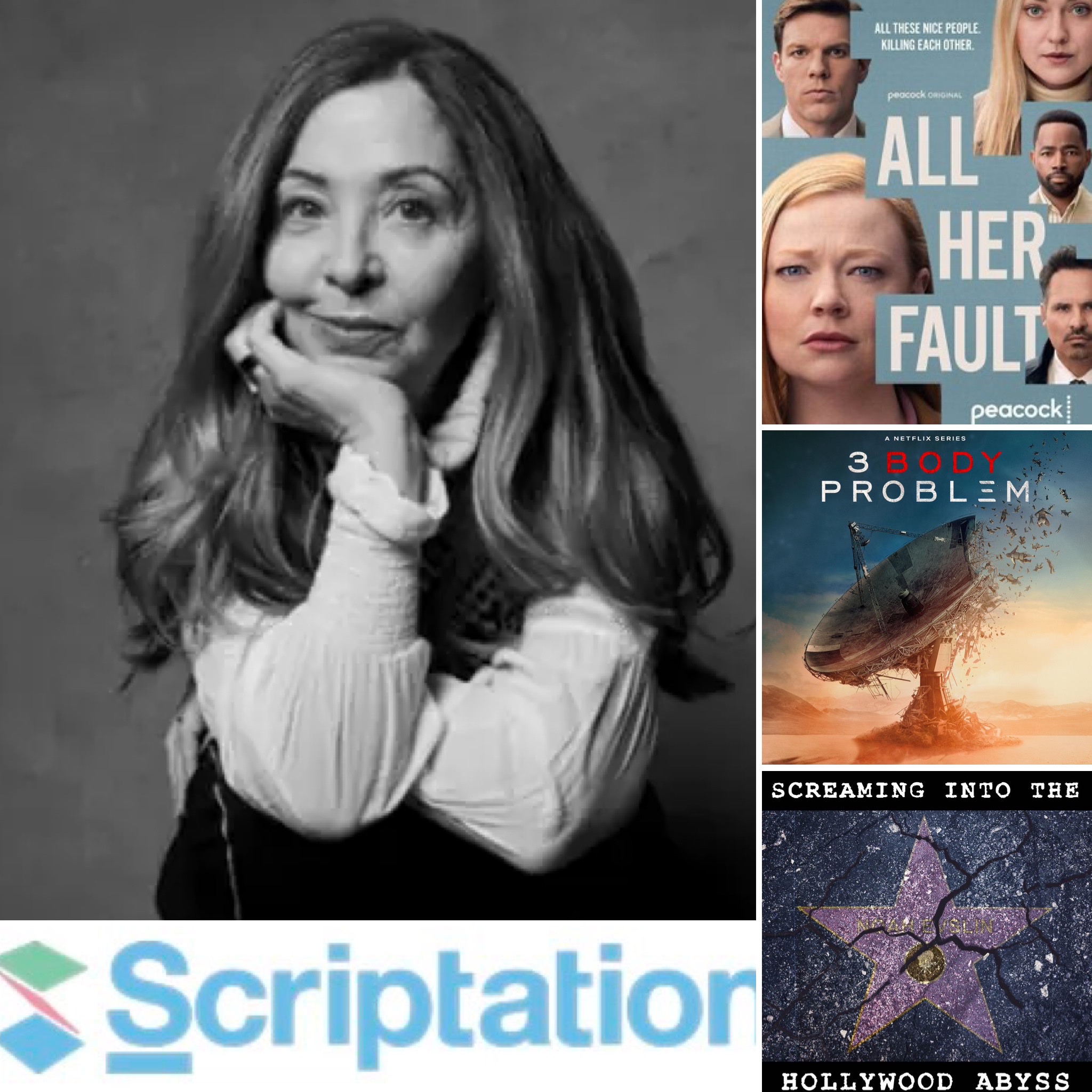
Take 155 - Executive producer, director Minkie Spiro, All Her Fault, 3 Body Problem, Rat Women

 Apple Podcasts
 Spotify
 Podchaser
 RSS Feed
 We have the remarkable Minkie Spiro on the show. Heavily Emmy nominated for All Her Fault, she talks about her start in documentaries, the family disapproval of her career choices and what she learned on Holby City.
We talk about being pissed on by rats and what that teaches you about life, she uses some great British phrases and we discuss award shows.
We talk Downton Abbey, 3 Body Problem and show producing compared to directing.
One of our funniest and most brightest episodes with a legend.
Any of us who've been in it for long enough, our entire career has been littered with jobs that we didn't get, projects that we thought were gonna go for shore, dozens of unproduced scripts littering for.
SPEAKER_02All of us are running into both major and minor failures in Hollywood every single day. This is one of the only businesses I can think of where failure is the default.
SPEAKER_01And I probably lost it. That's it for me. I think I want to shot what I've realized from that moment is it's never one big shot. There will be other shots.
SPEAKER_00Welcome back to Streaming Into the Hollywood Abyss, a podcast about rejection, failure, and adversity in the entertainment industry, brought to you by the Emmy Award-winning annotation software Scriptation. As ever, I am Dan Rutstein, your non-entertainment co-host.
SPEAKER_03And I'm your still in the entertainment industry, but not British co-host, Noah Eveswin. On today's Screaming Into the Hollywood Abyss, I'm thrilled to introduce award-winning TV director and executive producer Minky Spiro to the podcast. She's directed episodes of tons of your favorite shows, including but not limited to Downton Abbey, Better Call Saul, Fosse Verdin, Sperry, The Three Body Problem, and All Her Fault, which she also executive produces. Welcome, Minky.
SPEAKER_04Thank you.
SPEAKER_00This is awkward as a British person, it's awkward to ask another British person about their failures, but that is sort of the point of the of the podcast.
SPEAKER_04Um I'm glad you brought me on then.
SPEAKER_00Well, you look, you've obviously you got some incredible credits and you've won lots of awards. Um, but obviously it's never that simple. Um so tell us, you've made it look effortless. Has it been effortless and success all the way, Minky?
SPEAKER_04Anything but that. And you know what's so funny is that like, you know, you see an actor and they go from suddenly they're like this overnight success, but nobody actually looks at their at all the the hard blood, sweat, and tears of you know, doing off-Broadway theatre and and all sorts of short films. And I would say the same for myself, that you know, first of all, I I entered the industry very uh obscurely. Um both my parents are academics, um, nobody in my in my family is in this industry. It wasn't on my radar, we didn't have a TV at home. It was just, you know, read books, go to museums kind of upbringing, which sounds terrible. Um and it but it wasn't. Um in any event, uh, I became the black sheep when I entered this world. But I started off as a photographer and then a uh a documentary filmmaker, and then I sort of stumbled into an opportunity that came my way when you'll not you'll know this show, Dan, but um uh Holby City, which is this really very mediocre, satisfactory medical drama, and they were trying to reinvigorate it, and somebody had seen one of my documentaries that was kind of visual and funny and captivating, and said, Would I like to come and help reinvent that show? And I came and and and did it, having never been on a on a drama set before, and the rest is history. I just felt like I'd found my home, but it it was a it was a very difficult journey after that. So I'm trying to think what the American equivalent of Holby City is because it's not ER because ER was no, it it's like a low-level uh it's a day it's almost like an equivalent of a daytime medical drama, but it wasn't a daytime medical drama, it was an evening show. I mean, I'm I'm not doing it, I'm doing it a disservice. I'm just I'm just being dramatic in the sense of like, you know, it wasn't like some highbrow show.
SPEAKER_00No, I mean Holby City and and The Bill, which was the police equivalent, basically every actor in Britain has been a guest star on probably both of those at some point. And lots of people have become incredible in the same way that here they do episodes of Law and Order where they'll show people who were nobody when they were a you know a criminal in season two and now they're a big star. I think it is a bit of a breeding ground, although it's a very strong.
SPEAKER_04It no, it really is a fantastic way in because you know, I say this, I say this with jest, but you could almost not be there and it would still go on. I mean, it's such a well-oiled machine. Um, but the amazing thing was I ended up getting nominated for a BAFTA for it as best new director, which is kind of insane, but sort of probably my best ever nomination. My, you know, it it to be nominated alongside some huge high production value um shows like Dr. Shafago and then Minky Spiro for Holby City was, you know, a bit of a coup. Um it's all gone downhill after that.
SPEAKER_00So I mean, how so you've got your Holby City, which is great, and you get nominated, which is great, but how how does you know the daughter of academics from North London make it to like very much to Hollywood, working on shows with the Game of Thrones people on Netflix? Now you've got you know one of the the most popular shows on um on Peacock working with you know some of the biggest stars. Like that's quite a that's quite an adventure.
SPEAKER_04It is, and you know what? That's kind of how anyone entering this industry has to behave. It's an adventure, and you're gonna fall, you're gonna, you know, you're gonna get egg on your face, you're gonna be bruised, you're gonna be rejected, you're gonna have all of those things, but you gotta pick up, you gotta pick yourself up. It's like one of my daughters, when she was younger, she fell and she'd hurt her knee and she'd just get up and she'd squeeze her knee until like the pain went, and then she'd just get on with it. And I kind of feel like that's what we have to do. We've got to put our armor back on and and keep going. And and that's in a way when you know that this is the right industry for you. This is your calling, because you just even with all the knockbacks, you don't give up. You you you you persist, you sustain, you keep learning, you yeah.
SPEAKER_03We're we're gonna come back to all of the persisting and sustaining part because I'm really curious. But I'm I want to get really kind of in the nitty-gritty, because you you you talked about, and sorry, uh the name of the show is the hobby. Well, the name of the show is Holby.
SPEAKER_04Holby, yeah.
SPEAKER_03Holby Holby City. Okay, so you get this amazing opportunity on Holby City, which is uh uh a medical show, and I've worked on a number of medical shows. And the the uh and you're a documentarian by before this. So today I I I wanted to get into your mindset. It's a huge opportunity. You're switching into a whole new genre. How did you prepare for this opportunity? And were you scared?
SPEAKER_04Oh my god. I mean, if you'd given me this opportunity today, knowing what I know now, I would have run a mile. I mean, it's I I don't know what kind of audacity I had in my head to think that it was that it was that it was cool to just say yes without truly understanding what it meant. It does actually remind me of one other thing, and I'll get back to what it felt like. But I remember when I started working in US television, and one of my first jobs was following Ron Howard. Um, so he was directing the Pilot of Genius with um uh it's gonna get Einstein, um uh the Australian actor, Jeffrey Rush. And so he was given a very considerable healthy amount of days for his pilot episode. And I was following with episodes two and three. And I remember my wonderful agents at WME actually calling me and saying, you know, they're desperate to have you come and do second block follow-on from Ron Howard, but you sure you want to do that? Do you really want to go after Ron Howard because you're gonna get half the amount of days and you're gonna be under the spotlight? And I'm like, yeah, yeah, sure, it's fine. Truly not comprehending what that meant. And then I remember arriving on set, and there was Ron Howard and his first AD who I inherited, and I was just like, what was I thinking? And the same thing happened when I walked onto the set of Holby. I had no idea what um what I was letting myself in for. But and and I was, I was, how do I say this politely? I was I was cacking bricks. I mean, I was just I was just like a sponge trying to process everything that was in front of me. But weirdly, everything just fell into place. Like it just felt natural. It felt I felt comfortable. I I mean, obviously the adrenaline was and the cortisol and everything was spiking through the roof, and I was clearly faking it till I make it in so many ways, because I didn't, I didn't have the tools. I didn't, I you know, I felt like a fraud. But talking to the actors, having come from a photographic background, uh it just felt like a dance almost, and weirdly, almost easier than making documentaries because everything was organized ahead of time. You could arrive on set, you knew what the actors were gonna say. You know, often as a documentarian, you do all this research, you you really dig in, and then you arrive with this humble camera crew trying to be invisible and and extract interesting interviews and information from a character, but you're never guaranteed that they're gonna say to you what they said to you while you were interviewing them for research. But here I was without that anxiety of am I gonna get the story? Because actors are just saying what they've been told to say. So I knew what in it's a very odd thing to say, but it almost felt um easier and and less precarious. Obviously, I've had to get up to speed with my skills and the craft, and I keep learning every day, and every time I start a new job, but um yeah, I don't I don't know how else to put it.
SPEAKER_03Funny, so you you talked about uh the very British term kacking bricks, and I remember it reminded me of my first time that I went to set as a young writer, and the showrunner at the time gave me a little like pep talk. And and it summed up to basically never let them see your sweat, the actors. Like never show we 100%. And I'm yeah, so and I was wondering if that was going like, were you yeah, were you showing your fear or were you just hiding it with every ounce of your beard?
SPEAKER_04Completely hiding it. I mean, it's hilarious. I'm the worst actress, I would say. Although weirdly, when I was at Sixth Moore College, which is like last few years of high school, the my head teacher said, You need to be an actress. This is this is your calling out just so how in in any world could you see that? But I guess that is where my act my my skills come in. That but but again, I think I I bring that back to documentary that you know when you're interviewing some I okay, I'll tell you a funny story. Um I don't know how long you got, but I'll quickly tell you a funny story. I was finishing uh my master's degree at the Royal College of Art, and um there was this this series on BBC 2 called 10 by 10, and it was 10 short films by 10 new directors, and they did half fiction, half non-fiction. So I was beavering away in the library trying to come up with an idea that would really work within that short time frame. And I and I found this crazy um society of uh of fancy rap lovers. And so I like these are the people that have hundreds of rats in their home that that that that roam free range. And nobody until this moment had ever gained access to this society because obviously they're petrified of being ridiculed. Um, anyway, so I wrote to this the present, a female lady, and I explained that I'm fascinated and I love rats, and I'd love to come and learn more about your society. So obviously, unbeknownst to me, she's putting me through a test. And so she she she invites me to have lunch at her house, and I arrive, and there's this wonderful display of food on the table alongside hundreds of rats that are crawling all over it and pissing all over me. And I mean, I'm literally like petrified, and my skin is crawling, and yet I'm this contument. Yeah, I'm gonna eat and drink my cup of tea and pretend like this is all totally cool. I mean, literally, it was a living nightmare. And I remember coming back to my apartment and standing in the shower with all my clothes because I'd literally been pissed on by maybe a hundred rats because they marked their territory. Anyway, so it, you know, no, you have to do that in documentary. So, in a way, I was ex making an extension of that when I was talking to actors and you know, talking about um uh how I felt, you know, you when you how I felt they needed to push that particular performance. And again, being from a documentary, sorry to keep banging on about documentary, but you know, you smell bullshit in documentary. Like you can smell when somebody's not being honest with you. And so I I have that radar with with actors as well. But obviously, the biggest hurdle in a show that's a long-running show is that you're just this episodic director that comes in, and they often try and use that classic phrase, I know my character better than you, if they don't like the note you're giving them. So somehow you have to navigate um some very vocal actors who probably are tired, probably have had enough, they want to go home, whatever. And there's this like energetic new director that comes in and wants to, in their mind, reinvent the wheel. And so you're giving them a note because you've seen their performances and you just think it's you know, painting by numbers, and you want to kind of have a little bit more spike in it, and that's the the answer they give you. And and what do you say? I mean, it's true, they do know their characters better than you, so you have to find another charming, more you know, uh you have to try and come around it uh at it at from a different angle in order to get them. But you know, obviously, this is your first job, and you don't know any of these um tricks or expressions that actors are gonna be throwing at you in order to, you know, get their way.
SPEAKER_03I I I know Dan has a real question, but I just want to say we've done what 155 episodes or something. I think your story of the rats is the best metaphor for what it's like to work in Hollywood today or at any point in your anyone's career than anyone has ever given us on this show. So I'm gonna pass it over to Dan, but I just want to say that I'm fascinating story, and it's definitely applicable in all kinds of ways to what we do.
SPEAKER_04And if you want a little plug here, you can watch it on my website. It's it it is quite something. I mean, yeah. Anyway, sorry, Dan, I digress.
SPEAKER_00I can't believe we've managed to get through 155 episodes of this podcast without either A, somebody using the expression cacking bricks, and B, somebody sort of comparing talking to actors to being pissed on by rats, which I think is which is great. So um I think this is gonna be one of those. This is gonna go down as in legend. Will we we'll be sending this to the award shows?
SPEAKER_04I I aim to please.
SPEAKER_00Um, I also can't believe that Noah managed to work on however many seasons of Grey's Anatomy he did without going back to source material from Holby City to give them ideas.
SPEAKER_04Um I mean, really, that's impressive.
SPEAKER_00Um so I'm gonna ask a question which on the face of it might seem slightly silly, but I think it's a real question because I I saw versions of this when I worked at the British Consulate over here, which is how Americ sorry, how British people are treated in America, and for better and for worse, in terms of I think there is well, we used to give talks to visiting groups of businesses and various people about like what it's like being British in America. And you sort of, I used to say, you used to get like a 10% leeway in a meeting at the beginning because you're British. And obviously, if you can't, if there's nothing behind it, you don't get anywhere, but you get a head start in every meeting because there is a view quite positive of British people over here. For you who've obviously come and done some very impressive things in in Hollywood, um has how have you found the the Britishness of it? Has it helped you in terms of being a uh to charm your way through the beginnings of meetings, or has he has it, has it been a positive, do you think?
SPEAKER_04Um it's an interesting question because I I I obviously forget that I have an accent because it's normal to me. Um and and I it's true, I I I do think every so often people say to me, Oh, British people sound so much more intelligent, which I I I I dispute. But but but what I would say, and as you say, Dan, if you don't have substance behind what you're saying, you you you you're you're caught out within within minutes. But I would say the thing that helped me more breaking into the US market was actually that I'd that I'd honed my craft in the UK. And I I I had done, I don't know, maybe 45 hours of directing episodic and pilot television in the UK. So that when I came over to the US, obviously, weirdly, I had to, not weirdly, I had to start from scratch. I had to take two steps back. I couldn't just come here and do pilots. I had to become an episodic director again. They needed to know that I could work the US system within their constraints, meet the days, be able to work with American actors, be able to work with showrunners, which is a different format than what we work with in the UK. And I think that again, it was like this positive thing for me that I had a showrunner. Like in the in the UK, I have to literally hold the fort with no one at my side to like discuss or you know, have we got it? It's just it's down to me to to know I've got it in the can, I can move on to the next setup. And so um, apart from having to take two steps back and and and and become an episodic director for a while, um, I think what helped me was being British because I had worked in the British system of television, where you're not seen as much as a gun for hire, and they value your script notes, and you work in posts, you don't just do five days, you work through the entire uh gamut of posts. So you do you do all the exec notes, all the network notes, studio network notes in the room with the editor, even as just a director, not even as a producer on that show. So I think you actually come with so much more knowledge to the table as an episodic director in the US. And then people suddenly respect and see and cherish what you're bringing to the table. And hopefully the accent is just the icing on the cake. But I I I agree there is there is a there is a different um attitude in the beginning to British people. But I think if you cannot step up to that mark beyond the accent, then you you know you're you're thrown by the wayside soon enough.
SPEAKER_00Yeah, I think I think that's right. I mean, yeah, and as a clarifying point, there are, and I've met lots of them, there are plenty of charlatans out here who just trade off the accent and it actually doesn't get them anywhere apart from maybe the first meeting. Um I think, you know, no, what we talked about this before. I think one day we should do a special on the similarities and differences because we've we've had this whole, you know, showrunner, writing room. No showrunner, no writing room, and how here you know you've got 12 people writing a show, and over there it can sometimes just be you. Um, and I think it's it's there's some there's some very interesting differences about how you end up making very good television, which both countries do. In terms of a sort of a next question, I think um let's move on to your your new show. So um it's got very big names in it who've had some great success, you know, relatively recently. Um it's twisty and complicated. Um in terms of getting it made, um there must be a non-direct route to getting it made and it being a success. Tell me sort of the struggles to get this. This can't be the one show in the history of television that was really easy to get everything sorted out for. Or was it?
SPEAKER_04I mean, there they've been harder shows, uh, for sure. But uh what I would say about this show, it the things that were the curveballs, I would say, are that once we were meant to be shooting this in Toronto, and once Sarah Snook came on board, the the agreement was that we would we would pivot and shoot it in Melbourne so that she could be home with her family, her young daughter and husband and an extended family before she had to go on to Broadway to do uh picture of Dorian Gray again. And we had a very small window. So those were the things that actually made this difficult. Not the logistics is where it started to become complicated because we now had a lead actress that we loved and wanted to use, but we had a very finite window to get her. And so juggling and scheduling and having to then shoot in Chicago, but not have her with us in Chicago, shooting in Melbourne and having to bring US cast over, because that was one of my concerns, is that if we were shooting in Melbourne, I didn't want it to feel like, oh, we had one big name and everyone else was local. Not that there aren't phenomenal actors in Australia, but I wanted to balance, uh I wanted to circle Sarah with other Americans so it did truly feel like an American show, but also that she was surrounded by Americans so that her accent didn't get uh so that she could relax about that. So things like that were more challenging um than anything else on this show.
SPEAKER_00No, you've muted yourself, which is a few times I've done that.
SPEAKER_03Very excited for uh All or Fall to come out. I have some more, a couple more nuts and bolts questions that I'm just sort of really curious about. Uh and and this is a rare opportunity for us because in our show, uh Dan, correct me if I'm wrong, we've had a number of uh directors on, but it's it's it's much smaller than the amount of writers we have on. We mostly have writers and showrunners on this show. And you, you know, obviously uh deal with writers and showrunners from a different perspective. So here's your opportunity to give a piece of advice. We're gonna talk about some advice things later, but here's an opportunity to give a piece of advice to a writer as a director, episodic director on set. What kind of advice would you give them to just better sort of curate their relationship, not only with you, but with just the director in general who is on set?
SPEAKER_04So you're talking about a writer, not a showrunner.
SPEAKER_03Yeah, yes, a right, any writer on set who is kind of interacting with you for the first time, or any director, what are some things that you see them sort of the ways that you often see them falling down is a better way to phrase that.
SPEAKER_04That's such a great question. And I wish I had more time to think before answering, but I'll try and I'll try and come up with something um valuable. I mean I think the most important thing is to not be scared of the director and to all the actors and to be able to have a dialogue. Sorry, can you bear with me? I need to tell my daughters to be unless you can't hear them.
SPEAKER_00We can't hear them.
SPEAKER_04Okay, perfect. Uh so I'll start again. Um I I think it's quite intimidating coming onto a set, whether you're a writer, an actor, or a director. And I think for writers it's almost worse because they spend so much time in a room, either by themselves or with a couple of other writers. They don't inhabit this very energetic, crazy uh uh circus that that that that exists on set. And I think that's quite a lot to process when you first begin as a writer. So I think the most important thing is to ask questions. I say that to all my crew, and I don't mean that in a condescending way, but to just feel comfortable enough to ask a question to a director. And if they don't like something that the director's doing, I think there's a way to couch it that again can hide their fear about what's being done without becoming dictatorial or feel like they're saying uh a studio exec uh network note as opposed to what's coming from their soul. So I'll say, for example, I did Jessica Jones, and this was my first one of my early shows in the US. And I remember setting up this very cool shot, and it wasn't cool for the sake of being cool, it worked for the narrative. And I remember the writer, showrunner, coming up to me and saying, we don't do those kind of shots. And I said, I've I've I've done, and and it happens a lot. And uh I said, thank you, and I hear you, but would you mind? I've already just set up the camera, I'll just do one take of it and then we can move on. If I was to say to you that every single shot where a writer or a showrunner or an exec has said to me, we don't do shots like that, and they've ended up in the in the in the final uh episode, I not one of those shots has ended up on the cutting room floor. And and I think maybe I understand it it better because I've been in the edit for so many years. I've sat through, so I'm not gonna use the entire shot. I know that there's this one moment in that shot that I want to use, but I can't get that moment without doing it from the beginning of the take of the scene to the end of the take. And I explained to the execs or the writer, I'm I'm only gonna use a little bit of it. But but you know, and and I'm very polite. I, you know, that that's the other thing. It doesn't help to be antagonistic. Sure it pissed me off. Sure I felt like, you know, hold on a minute, why are you employing me to do this if you're telling me how I need to do my short? But you know, I I think it's all about explaining. And so when a writer wants to give a piece of a note to a director, explain where they're coming from. Don't just give the note, because a director doesn't know where it's coming from and may not understand the framework in which it's coming, because we all talk in shorthand on set in order to get the day done. Um, and I think, you know, uh uh the more a writer and director can spend time together prior to being on set, the better. And the more they can pick each other's brains in a tone meeting, the better. I think that most of the time people rushed through tone meetings and people made fun of me on Bedacle Saul. And I will I this person will rename will remain nameless. But I was on, I was doing a tone meeting for Bettercall Saul, and I was I was probably getting quite granular. But the more I know before I go on to set means that I can then unclip my wings and and fly. So this particular director had a two-hour tone meeting, and I had a 24-hour tone meeting. Obviously, it wasn't a 24-hour tone meeting, but they like to, you know, but but embellish the hours. And obviously, we had to stop start because the showrunner needs to go on set, etc. But that would be my biggest note to any writer is spend as much time with the director prior to being on set because set is such a different dynamic and it's much harder to get into each other's mindsets.
SPEAKER_03For me, it was that's a great answer. I I always always found the Tech Scouts so valuable because you'd spend a day in the van with the director. And I always tell my writers that I'm entering, use that day to really get to know the director because it's not just when they're, you know, when we're on the locations and they're walking through what they're going to do, it's all those hours of getting there. You get to know them, what they shot, what their sensibilities, and just come on, you know, if they realize you're an ally and not there to like, you know, to to compromise their vision in any way, it's a much better relationship from the jump.
SPEAKER_04Right. And and and the other thing is um it's it the more a writer can spend time with the director, the better the director can deliver. So for example, no, if you were to say to a writer, this is a really important scene for me. Whereas this one, it's a bit of a, I call it KBS, which is a kickbollock scramble. I mean, let's schedule it at the end of the day because that's not my priority. Because you don't want your babies to be at the end of the day when everyone is just scrambling to meet the day. So I also ask writers, what are the what are the most important scenes and which are the scenes that networks are on the fence about, studios are on the fence about, you're pushing to have it in in the schedule, they're wanting to cut it. It's like, or they want to potentially trim this scene, but I wanted to get all the dialogue in. So don't do a one-a, because they're going to be screwed in the edit. They're not going to be able to trim it. So knowing the sort of scenes where in advance they've already been warned that this scene is too long, get the coverage to enable the scene to be cut short because you, as a US director, will not be in the edit for the long game. So when they're cursing at the screen and saying, that director, they didn't give me the coverage to be able to do the scene the way the execs and the studio and the network are now insisting, and so it looks choppy and inelegant. You don't want to be that director. You want to be able for those showrunners and writers to say, wow, they delivered with bells on, and I can now mull this episode exactly how it needs to be. Because you don't know in the script stage how every actor's gonna be, and if a guest story is actually gonna land as well as it should. And so when people criticize and say, Oh, too much coverage, there is such a thing, but there's also the the other extreme, which is doing the one-as or or not giving you as as execs and showrunners the glue to be able to make the episode work.
SPEAKER_03I love that answer. I've never had a director ask, like, what are the scenes that are important to you? Obviously, that comes up in tone in different ways, and they're clocking that, but I mean, and that's we can go get sort of nerd out on what that means with the schedule and the first ADs. But I have um one more just failure question because again, we we we spend a lot of time with writers and writer failures, there's like, you know, exactly fell asleep during my pitch, or I worked for five years on a project and I didn't move forward. But I'm, you know, and we have less moments of pure visceral panic in front of an audience, meaning onset where like things are going sideways. So I'm really curious, you don't have to name a name of a show, but has there ever been a moment on set when you're shooting something where just everything is going wrong? And how did you steady the boat?
SPEAKER_04I mean, that's such a brilliant question, and yet like gives me gives me goosebumps of because they're uh, you know, like not butterflies, but that that that feeling you get when you're on set, and you know, the actor's drunk or hungover, the location has got a construction site that wasn't planned that suddenly broke out. The the person doesn't know the lines, they're in the wrong costume, it's about to rain, the sun's going down, you know, all the things that you cannot control. Uh or or like an actor turns around and says, This dialogue doesn't work, this scene doesn't work, and they get really arsy with the showrunner, and in turn myself, and they're they're kind of refusing to do it the way it is. And the showrunner doesn't know how to navigate this because they're new to the game, or they they they don't know how to change a script on on the hoof like this. It I mean I think um it's back to my rats on me. It's like I have to center myself, and I and I think I'm so like I'm like a scratch record, but I would say my documentary background has held me in such good stead because you don't have the luxury of time to consider and reevaluate. You've got to think on your feet. Okay, how do I where do I relocate the scene to? How do I get this actor to say the lines that they don't want to say? How do I get production to give me an extra 30 minutes because none of it was my fault, but they don't want to, because it's hot costs that they can't afford. I think the most important thing is to surround yourself by your key personnel. So take a moment, don't you know, to say, give me five, and you and you get in a huddle with your first AD, your DP, and your showrunner, possibly an exec on, and you just have a brainstorm. I'm often the one that's that's like driving it, and I'll say we could do this, and I can get them to do this, and we can do that. And and I think sharing is such an important part of our job, in the same way that my way or the highway just is is no way to work. We're all in it together. The same with the writer needs to know we are here for the same end game. We all want the best, most um compelling piece of television. And we're not gonna get it if we're if we're at loggerheads. And when and when the shit hits the fan and we have a disaster on set, that has to be resolved. We can't come back to this location. This actor has to fly out to New York tomorrow. We have to get the scene in the can. The most important thing is to keep a level head and to almost do this sort of um uh scenarios, different scenarios fast forward in your head. Okay, if we do it this way, this'll happen, but we'll compromise that. If we do so, you just dissect the moment, but don't, but, but don't ever be forced to on the spot give an answer. You need five minutes. Five minutes isn't a lot. It's better to actually talk it through, find the right solution than do a knee-jerk reaction and just come up with another problem. So I'm like, take a deep breath, walk away from the chaos, and just have a huddle and think. And sometimes I just need a few moments to myself to kind of think through what possible solutions we have, and then pitch it to the team and say, what do you think? And and often, you know, somebody's got a better idea, or it's a combo, or you know, that's the answer.
SPEAKER_00You're fast becoming one of my favorite guests, Minky. I just want to say that.
SPEAKER_04I bet you say that to everybody, but I love you for saying that.
SPEAKER_00I'll take it. And also for clarification, um, before Noah gets carried away, your initial responses to his last two questions were that's a great question, and what a brilliant question. Noah, just what that in in translation that means I need a little bit of time to think, but I want to be polite to my my hosts. So that's what she meant. Don't worry.
SPEAKER_04This is hilarious, Dan. I promise you, your next question will be a great question. He's just a little jealous.
SPEAKER_00You're getting the sense of that, Mickey.
SPEAKER_04Yeah, yeah.
SPEAKER_00Come on, come on. Um, so what's missing for you, career-wise? So um, is there is there something that you want to do that you haven't had a chance to do? Is there a documentary you want to go back and make now? Is there something on American TV? Do you want to revive the Bill and Holby City? Like what do something in the Star Wars and Marvel University? Like what's your sort of now you've reached a point where you've got a little bit more freedom than you would have had early in your career. What's the what's the thing you want to do next?
SPEAKER_04That is a great question.
SPEAKER_00I thought it would be.
SPEAKER_04Um goodness. I mean, I just want to keep doing what I'm doing and not get tapped on the shoulder and said you're a fraud, get the fuck out of here. No, I mean I like uh I feel nervous every time I do a job. I that that that moment of can I still do this or can I even do this exists no matter where I'm at in my career. That has never gone away. What I'd love to do still, and it sounds ridiculous, is a feature film. I I I'm a photographer by heart, so I'd love at some point in my career to make something for the big screen, just because that's what I've always dreamt of doing, whether it be documentary or fiction. And to just continue making shows that entertain but make people think. You know, what I love about all her fault was it was this really binge-worthy kind of delicious thriller. But there was substance to it. We were looking at, underneath it all, we were looking at the tapestry of the societal makeup of families and why is it that mothers I mean, I mean, I'm talking heterosexual um marriages primarily here, but why mums are just expected to do the heavy lifting? Like do the doctor's appointments, know everything about school and and and and and paperwork regarding that. And so it was really lovely to to be able to make a show that in this instance it doesn't have to always be about women, but in this instance, the feedback was from a lot of working mums, it felt good to be seen. It felt good to to know that our story is getting out there. Our this societal discrepancy is no longer either invisible or or taken as a given. So I mean that that's what I I I would love to do is to continue making shows that hit the zeitgeist, that get the audiences it deserves, that has that gets critical acclaim. I mean, who doesn't want to get an award? I mean, I'm I'm I'm I I I'd love one. Um but but you know, at the same time leaving a legacy of shows and stories that kind of make people think uh without hitting them over the head with a hammer in a in a kind of uh worthy way.
SPEAKER_00Excellent answer again. Like the we've got one last question, that's why. Well, it happens. Um we've got one last sort of real question before we do the question we ask everybody. Um and I was actually going to ask about awards, so you you brought it up, so it's perfect. So obviously, I think I think I saw on your Instagram some pictures of you going to, you know, looking like you're enjoying yourself getting ready and going to an award summary. Tell me, because obviously you've been going back to your Holby City nomination. You've you've you've been to lots of award shows um in the room with some obviously great people. Do you enjoy that part of the biz?
SPEAKER_04I mean, no, I don't go to those events generally. Um but when I'm there with a show that I feel really proud of, it's about the first time where I can actually relax and enjoy myself and just say, yeah, you know what? And and you have distance in the show, so you can sort of stop thinking about, oh man, I could have done that and I didn't do that, or shit, I missed that. You know, all the things that I I beat myself up about because I'm a perfectionist. But you know, that the the A certain thing about award shows. I mean, the biggest hassle is finding something to wear. I mean, it's really stressful. But no, I love them. I love them because I get to see people I haven't seen for a while. And um and just yeah, just relax. But yeah, we we we were very lucky with all her fault. We got uh we got Golden Globe nominations, we got Critics Choice Awards nominations, and I'm just keeping everything crossed that we can get some Emmy nominations now. Um not just for the show, but for me. I'm desperate to get an Emmy one day. So it'd be nice if if I got a nomination. That would be fab.
SPEAKER_03Well, it's a fantastic show. So all the Emmy people that vote on the Emmys who are listening, let's let's give a few votes this way. Okay. So uh it's leading to our very last question that we ask every single person that comes on to this show. And it's it's if you can give one piece of advice to somebody just entering the business, in your case as a director, what would that be?
SPEAKER_05There's so much I want to say. Um if I had to say one thing. I think um it's hard.
SPEAKER_04You know, and I I I came to this when there were only three percent of female directors in the industry. There there is no easy shortcut way in. It's it it takes grit, it takes determination, all the things everybody says. Um and whatever you do, um, what am I trying to say? Um I think apart from not giving up, I would say expose yourself to as much as many opportunities where you can learn the craft the better. You don't want to be on set for the first time directing. So even if financially this is tough, I know, I get it, I slept on people's couches for years. I didn't, you know, my as my friends and siblings were all getting on the property ladder, I didn't. But get onto that set, be a PA, be an assistant, because what you learn there is so much more valuable than what you learn at uh at film school or in the books. Watching how I or a another director navigates these very difficult um curveballs that happen on set, you can't you can't teach that. But if you can, if by proximity you can be around this and watch how directors talk to actors, watch how they dissect a scene in terms of coverage, watch how they navigate the day. These are the most invaluable pieces of information to give you the tools to be able to get on set and do your thing. You can read about how to uh analyse a scene from tons of books and podcasts and and and and YouTube, but actually being in the trenches and and waking up at silly o'clock and seeing how long a day is and and being on that marathon, to me, proximity is everything. So uh so that would be my best advice alongside never give up.
SPEAKER_00Fantastic. Well, a great final answer at the end of an excellent podcast episode. Um, Minky Spiro, thank you very much. You were an excellent guest, not just because of your accent, but because of the substance behind it. Um, so thank you for the um the uh the cact bricks and the rat piss and all the things that will make this episode memorable. Um and thank you very much indeed for coming on our show.
SPEAKER_04Thank you. That was the the most fun I've had in a long time. Seriously. No, I don't.
SPEAKER_03Thank you so much for listening, and thank you, King Father. As always, each episode is brought to you by scriptation, my favorite screenwriting annotation software. If you want to support the show, please download a copy at www.scriptation.com slash but it's www.scriptation.com slash if you want to find me on social media. I'm at more recently on the social media because we be using the care about the