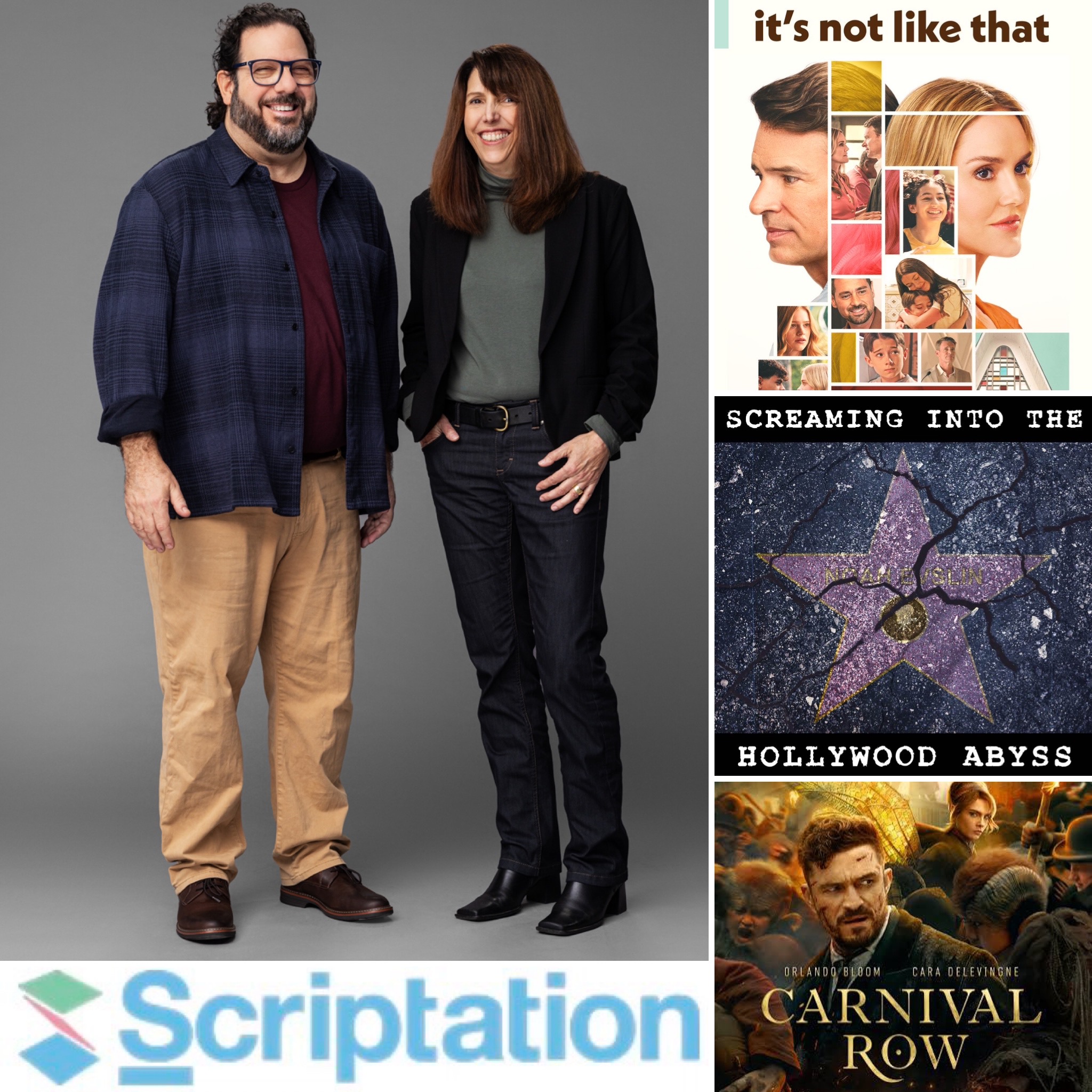
Take 153 - Showrunners and Writers Kristin Robinson and Ian Deitchman, It’s Not Like That

 Apple Podcasts
 Spotify
 Podchaser
 RSS Feed
 We welcome the dynamic writing duo of Ian Deitchman and Kristin Robinson to the show.
We talk about celebrating wins together, the mechanics of a writing pair and their new show It’s Not Like That.
They tell us why they have a shared inbox, being mistaken for a couple couple and the changing dynamics of writing rooms.
A deep dive into the world of writing partners navigating today’s TV landscape.
Any of us who've been in it for long enough, our entire career has been littered with jobs that we didn't get, projects that we thought were gonna go for shore, dozens of unproduced scripts littering the floor.
SPEAKER_04All of us are running into both major and minor failures in Hollywood every single day.
SPEAKER_02For every success, there is months, sometimes even years, of painful failure. This is one of the only businesses I can think of where failure is the default.
SPEAKER_04That's the norm. You have to be able to persevere. Like everything in our business, your hands get counted and it all bounces off you.
SPEAKER_00That process takes care of that doesn't happen overnight. I was being told by my manager it's yours to lose, and I promptly lost it. And I remember thinking like, well, that's it for me. I blew my one big shot. What I've realized from that moment is it's never one big shot. There will be other shots.
SPEAKER_02As ever, I am Dan Rutstein, your non-entertainment co-host.
SPEAKER_05And I am your still in the entertainment industry co-host, Noah Epson. On today's Screaming Into the Hollywood Abyss, I'm thrilled to introduce uh TV writers, screenwriters, and now show creators and showrunners, Ian Dykesman and Tristan Robinson, to the podcast. On top of a long feature career, including the film Life as We Know It, they've ridden on such TV series as Parenthood, Carnival Row, The Bold Type, Suits Off Campus, and Others before creating the upcoming Amazon series starring Scott Foley titled It's Not Like That. Welcome, Ian and Kristen.
SPEAKER_01Thank you. Thank you for having us, guys.
SPEAKER_02Yeah. This is a possibly marginally lazy question, um, which I ask of people who've had lots of credits, which is where have you had time to fail in between doing this many different shows?
SPEAKER_03Well, uh, you know, we were in features for a long time before we got into television. And uh our joke about uh when we got on our first TV credit was Parenthood. We we came onto Parenthood in season five as staff writers after too many years in features, and we describe it as like um, you know, in The Matrix when like the claw pulls uh uh Neo out of the muck. That was Jason Cadem's pulling us out of feature screenwriting careers. Uh we were just limp, plopped into the the parenthood writer's room, and we were just like literally after the first day we we drove home together, we're like, well, I could do this for the next decade, you know. It was so amazing.
SPEAKER_02Fantastic. Um how no one no one likes to do things chronologically. Um I I don't. Um, but you started it by talking about the beginning. So let's let's stay chronology. How much floundering was going on for you in the in the features world um before you got saved?
SPEAKER_01A lot, a lot of floundering. So the the the the one produced credit that Noah referenced life as we know it was almost 10 years between when we wrote it and sold it and when it was made. So and that I don't think is necessarily abnormal, but that is a long time. Now it served us as a sample and we worked in between then, but there is a lot of heartbreak and hustle and rejection to go to the theme of your show in between those things. So um our motto is always be writing, because that's really the only thing you can control during that time when people are saying no, right and left. Um, so we've just kept on keeping on. But that that's one example.
SPEAKER_02How bad did it get? As in uh is there a chance that you two could be on shows now about being doctors or lawyers or retail assistants or whatever you nearly ended up doing?
SPEAKER_03I mean, listen, there were, you know, uh first of all, just as writing partners, we're splitting a salary, so that makes things in in inherently twice as hard when there's two families that we're trying to support, uh, each of us. We are not married to each other. That's a key question that everybody asks.
SPEAKER_01It is a creative marriage. Oh yes.
SPEAKER_03Uh we always say our mojo is that there is no mojo. Um and um, you know, so uh especially in features, you know, we uh you know, you the kind of writing that we uh, you know, move towards is romantic comedy, romantic dramedy, probably to a fault. You know, did you ever play Kristen Jr. or play uh Dungeons and Dragons? I didn't.
SPEAKER_01Yes, I did, but yes. You did? Yes, oh yeah, my brother, anyway. Oh, I didn't know that's a sort of yeah, yeah.
SPEAKER_03Well, but somehow we didn't move towards genre writing or anything like that. And it's like the you know, we grew up uh each of us on like we have many different, you know, point, you know, like uh genres that we love, but I think points of connection were like Jim Brooks movies, Cameron Crow movies, and uh those are just insanely hard to get made and sold. And so we had a pretty good track record of selling pitches, but it would always be like 18 months. So you'd sell it, it'd keep you going, and then it's like, okay, uh, what are we gonna do? And then it's like the crops are saved. We sold something just in time. That happened numerous times where truly sweating it.
SPEAKER_01Yeah. So, Dan, the precipice you're talking about, we've been there often. And because there are two of us, it happens at different times, as Ian said. Yeah. Um, depending on where we have kids not together, as Ian said, depending on sort of where the financial threshold was. It was, well, what are we gonna do to bridge the gap? And always comes the question um, is this it? Have we reached that point? Do we have to go find something else to do? And and somehow we really have managed. Um, it seems just when things would get to that point, something would come through. Um, but we've been there. And I that's one of the reasons that I love uh your specific podcast is because I think that is baked into the reality of what it means to be a writer in this business. And the quicker people get comfortable with that, the easier it'll be. That's why I said, where were you guys when I needed this kind of dev talk so many years ago?
SPEAKER_03Anyway, I mean, I'll tell you that when life as we know it got made, um that was a tricky year for us because that that was when really movies were really starting to dip for the first time. And um and so um we were struggling to find work. We managed to sell something. The week our movie was released, we sold something, and that was pretty amazing. That was like, oh, that's a week. I want to have a lot more weeks like that where our movie is released and we sell something, but we hadn't worked in a while. And then after that job, there was a solid like two-year period of really struggling to get more work, even though we had had a movie released, and you know, we fell off of uh we ended up using points for health insurance. We fell I I was um I ended up short selling my house because uh like you know, the um the uh I talked about all this when I ran for the board. So it's no, I'm not I don't care, and then we used it for parenthood, so you know, but these were the travails of like the reality was like uh speaking for myself personally, I got caught up in that whole zero interest down, uh, you know, um uh real estate bubble that blew up. And you know, we ultimately short-sold our house and moved my family. We moved to a rental in North Hollywood, the No Ho years, as we call them. And um, so Parenthood happened. Uh it was kind of of it was kind of amazing. And the irony is that this script this show, it's not like that, that we've been working on this year. That was the spec pilot that we wrote that actually got us the job on parenthood. So it was an old spec that actually out of nowhere this two years ago turned into our first creative, you know, the first show we created. Yeah, you just never know how this stuff works, you know, it's planting seeds.
SPEAKER_05I love hearing that. I love hearing that a spec pilot from your first job, because one of my favorite specs I've written was actually got me my first job too. And I'm like, this thing's gonna come back to life one day, and you just proved it. I do want to make just for the people listening, like, comment on the fact that after a 10-year feature career and a movie made, you still come into the room as staff writer, as the lowest level writer. It happened to me too. I sold four pilots or something, and I'm like, not only did I come in staff writer, the next show I went on, my first offer was staff writer for two years again. And I'm like, but I just did staff writer and I did all these things. They don't care. They're like, BA is gonna put you at the bottom. But I'm gonna ask you a real sort of granular question. We're gonna move off of features in a second to more on your TV stuff, uh, which will lead to some of your successes. But the uh what is what was your absolute worst experience? You don't have to name names in your feature career. I mean, I I know one if you know.
SPEAKER_01So now you go. I'm I'm gonna guess. I think I know.
SPEAKER_03Um, it was a project, I won't use names, where we were working with a director, and we weren't really clicking with the director, and there was an executive at the company, and uh they clearly had a version of the movie that they wanted to do. And this was an open writing assignment that we had gotten. Um, and they told us the two of them wanted to do a pass of our script before it went up the line to the head of the studio. And we said, Well, we want to read it first, and you need to tell that person that you did this. You can't just submit it as our writing. They did not send it to us, or if they did, I can't remember. They sent it to us as they sent it to that the head of the studio and did not tell the head of the studio that he they submitted it as if it was our writing, even though they had done their own, the executive and the director had done their own rewrite. And we had our agent call the head of the studio and basically kill the project, or at least certainly take our names off of it. We basically said, This is not speak for our writing, this is what they did. We called them out. Uh, they were very apologetic to us, and then we never heard from them again. But that was that felt really like not in good faith. And we were just like, no one is going to no one is going to speak for our writing other than us.
SPEAKER_05Well, that is all I mean, I that that that's up there with awful stories. I've heard I actually heard a story not that long ago of a high-level uh studio executive who used to rewrite the feature writers himself as the drafts were coming in, which is its own brutal. Like and not maybe not mention that or or maybe mention it, I don't know. The future feature world is is is I've I've heard a lot of these stories. I've been in TV for most of my career dabbling in features, but mostly TV. Uh follow-up feature into TV question, you mentioned it as getting lifted out of the muck. Um, and I've I've had people, I started as a feature writer and I had a TV writer mentor say, no, you have to do TV. Like TV, it's it's the grass, it literally is greener over here. No, maybe not so much anymore. We could we can get into that. But like, what was that sort of epiphany moment where you're like, this actually is better, like being on this side of the fence on in the parenthood room?
SPEAKER_01Well, they stopped. The industry really stopped making the kind of movies that Ian and I write, or at least the industry, as we knew it, like major studios and whatnot, meaning rom-coms and sort of dramedies. And the more creative stuff was happening in television. And we got super lucky in that um a fan, uh someone who'd been a fan of our script life as we know it before it was made, ended up in a uh ended up working for Jason Kadem's, uh, running his company and development. So she knew of us. And when there was a turnover, and there was never a lot of turnover on Jason Jason's shows because writers love him and want to work with him again. But what happened is in success, some writers moved on to do other projects. So there was an opening. So the sort of the combination of really lucky events, which is this particular executive, Michelle Lee, knowing our writing, and the spec, the, the, the script Ian's talking about that then became the show that we just produced was our sample. Because she was there and knew us, and because then she put our script on the top of his pile, Jason read us and we ended up there. So it there's such an amount of luck in that equation. They liked our writing, that's great. Um, Michelle loved our other script, also great, but a lot of things have to happen um to kind of make that transition, and luckily did for us, but it it, you know, um it's uh it's a journey.
SPEAKER_03And I'll tell you the the just to add to what Kristen's saying, I mean, that that showrunner meeting with Jason, uh, one of the things that was amazing about all of that was how we were so used to features where it was like you go in and you'd pitch, and then weeks later you'd come back. And like the whole getting hired on a parenthood happened in like a three-day period. It happened insanely quick. And, you know, we of course prepped for the meeting with Jason. We had already been fans of the show and had been watching all of it, but um, you know, we had ideas. I was like, this is season five, guys, you're gonna need to go in there with ideas. So we go in there, we have ideas for every character. He doesn't want to hear any of that. It was really just to get to know you. And up until that point, we had been having like coffees, dinners with friends of ours who were TV writers, basically saying, How do we do this? We have to get into television. Like the feature world is for what like Kristen said, is closing down on the kind of movies we make. It's all in TV now and getting advice on this. And I remember a friend of mine uh saying, I'm gonna tell you how not to do a meeting with Shonda Rhimes. Uh, and and it's this uh don't keep cutting her off when she talks. Like if she has, if she wants to let her talk, don't feel like you gotta get it in there. And so Jason in our meeting with him was like, Do you have any questions? And then we kind of talked about anything. And then he asked again, Do you have any questions? And it was like a little bubble, like, ask him a question. And we were like, you know, asked him about how does the show work and how do you how does a writer's room work and all this, and he was great. He went into it, and then at the end of it, he said to us, um, uh, oh, I I said to him, um, he asked us, he said, Do you have any other questions for me or uh something like that? And I, you know, we basically said, um, or we asked him, Do you have any more questions for us? And he said, I just want to know, like you guys have you had a movie made, you've been feature writers for a long time. It's not often that we get writers coming in at a staff writer level who have had, you know, however many years of experience already. And we just said to him, you know what? We're, you know, we feel like we have a lot to contribute, and we feel like we have a lot to learn, and we're really excited to do both. And I've always felt like that answer is ultimately what got us that job, and it was coming from a very true place, which is like that is how we've always felt. It's like, you know, you you have to have um, you have to in this industry be both incredibly humble and kind of incredibly confident at the same time. Um so yeah. And then two days later, it's like you're hired. We're like, what? There's not gonna be eight more meetings.
SPEAKER_02Amazing. So um I don't normally do this because the people listening will have no idea what I'm talking about. But for for our guests, if you're wondering why I keep disappearing off screen, um, is because Noah gave me a dog about four years ago when he moved to Hawaii. Um, and the dog is now wearing a cone because he's got the hamster dogs, and he's having all sorts of-I don't know if we've ever had a dog wearing a cone for the first time, he's causing absolute havoc around our house.
SPEAKER_05Um, my poor dog in British sweaters, and um I you know he's probably trying to commit suicide over there. That's what's really happening, but uh that's a digression.
SPEAKER_03This moron behind me is uh there's literally not a thought going through her head.
SPEAKER_02I'm doing a page one rewrite on trading this dog after the things Noah did to him. Um, anyway, so apologies for ducking on off screen. Anyway, back to questions. So um I don't know anything. I I mean I'm learning a lot about Hollywood by doing this podcast, but obviously I'm not in this world. And I always find writing partners fascinating. I think Noah might have accused me on one of the earlier episodes of trying to break up a partnership by asking lots of questions about like how you argue with each other and so on. So I want to just go out there and say I'm not trying to break this partnership up, but I do have some questions. Um I guess the first one is is actually could ask any partnership this. It's not necessarily about you two, but have you had any situation where you've been you know, you've pitched and there's been somebody's tried to be sneaky and come back and said, you know, this is great, you know, I want Kristen. I don't want Ian. Or do they ever I don't know what the rules are, I imagine they can't really do that. Is anyone else or said, I like what you do, but I don't like the other one? Or is that not a thing that happens?
SPEAKER_01Not exactly that, but it it's funny that you asked that question, because there's a producer who I also will not name, but who Ian and I pitched to, and then he only wrote emails after that pitch to Ian and not to me. Right. And we now share an email address for work, which was born of that experience. This is years and years ago. We don't really need to now, but it actually works out. We each have our own individual, but we have Dietwin Robinson that is our shared email, so that everything we both see everything that was in reaction to that experience. I don't think he was trying to break us up. I just think he had a comfort level, he was a dude, he had a comfort level with Ian, and that was just how it would, how it went. But interesting. That's my that's my partner story.
SPEAKER_03I I mean, yeah, I don't think any there's ne I I've certain I've not experienced well, I haven't experienced sexism like that, obviously. But like um the only thing that brings to mind is like when we first started in a writer's room in parenthood, you know, I think there was just us learning to uh uh just be in a room and like we are actually two different people, like do people see us as one person when uh um I I run my mouth, guys. I there no yeah, like can is it possible to get Ian to shut up? Uh so there, you know, it was kind of between the two of us finding a balance, you know. Um, because we were used to just kind of our own kind of give and take between the two of us for however many years. Um so that was an adjustment, but that wasn't because anybody said anything, that was just between us, just kind of figuring out how that works.
SPEAKER_02So you obviously I find the whole concept of sort of I guess it's because of the way the pay scales are done that you have to share a salary seems slightly crazy. Do you get your own lunch or when they go to Mendo, do you do you have to like do the half sandwich thing? No, no, we we get our own lunch.
SPEAKER_01We do get our own lunch. There was one production, and it was in the early days where Ian and I were first getting the opportunity to go to set, that they asked if we if we needed more than one hotel room. And I said, most decidedly. Yeah.
SPEAKER_03That would break us up.
SPEAKER_01That was odd, but I don't know. I'm I'm gonna chalk it up to maybe they the assistant thought we were married. But anyway, yes, they tried that. But we've never had to split a sandwich, Dan. No.
SPEAKER_02Good. I don't I don't know how it works. I mean, times are tough in Hollywood, maybe now you do have to split sandwiches. Oh yeah. Um so um I like asking questions about how people celebrate or com or commiserate with with themselves, as it were. But obviously, as a pair, what do you do when you when uh something raps or you get a job or whatever it is that's worth celebrating, how do you celebrate that? And also the flip side of that is when something has gone wrong, how do the two of you interact while commiserating each other or or dealing with some kind of failure?
SPEAKER_01It's funny, I think it's easier for me to answer the second part first, because sort of with the wins, it sometimes is always like, okay, but what happens after this job? Right. So we do have a pattern of when something ends, falling into a weird space of what now? And out of habit, we've learned to double down and just keep generating new material. As I said earlier, just you know, we're we we're always writing something. Now that might not, it might not ever turn into anything, but it keeps us creatively connected and inspired and focused. Um, so we tend to double down.
SPEAKER_03I feel like, you know, we used to early wins, you know, we sold, we we've had some big moments, right? Like our the when we finally sold our first spec script, Sandra Bullock was attached to it. It was a big, big sale. It was one of the it was it was late 90s, like 99, 2000, right on the cusp there. Of uh, and um it was a big script sale that was in variety. That was a double high five, you know, you know, we're taking our spouses out, we're all celebrating. It's like we're gonna we get to pay off 10 years of debt with this, but it was like, and now we're gonna work like crazy. And then it was like two years went by before we got the next feature job, which was us selling life as we know it. And it was like, okay, well, now we're gonna work forever. And then there was another drought, and it just and it would be like 16 months, and then we got another gig, and it was so you just learn like you're there's not there's no we'd be happy, we'd be pumped, and yes, we sold something excellent, but then it's like all right, let's buckle down to work, and what's the next thing? I will tell you, we one of our kind of big stories that we tell people is we I ran for the WGA board and got on, and that enabled me to meet some uh much more successful writers than me. And uh, I met Scott Frank, and Scott uh was like, Why don't you guys come out to Pasadena? I'll take you to lunch and we can chat. And this was in the lead up to Life as We Know It coming out, and we had sold a bunch of pitches in the years leading up to that, but we hadn't written a spec script, and he was like, Let me tell you what's gonna happen when your movie comes out, and we were not working at that moment, even though we had a movie in production and was gonna be coming out in a few months. He's like, It's gonna be great. Movie's gonna come out, everybody's gonna go see it, you're gonna get to do like the red carpet, there's gonna be a premiere, you're gonna get to go to a theater. And can I curse on this? Okay, so basically he's like, You're gonna go to a theater, it's gonna be amazing. You're gonna see people people watching your movie, and then you know what? After that, it's fucking done. And what the fuck are you working on now? And what are you writing? And it had occurred to us that's like we had been selling a lot of feature pitches, but we hadn't written a feature spec in years, and we realized it was like he's right, and that was where we got always be writing from was from Scott, because he was like, You should always, always be writing something of your own. And we wrote a feature script that we did not sell, hence short selling my home, and uh, but came very, very close. Other horrible stories about executives, um, and uh, and if we but in writing that feature script, we we really rediscovered our own collective voice, the two of us, and that's what enabled us to write the it's not like that pilot, which is what got us onto parenthood. And I always say, like, if we'd never actually written that spec feature, we never would have been able to write it's not like that. So it really always comes back to that for us, is really it's like we don't really celebrate, we don't high five so much anymore. No, not in a bad way. We're thrilled when good things happen, but it's always like, okay, but what we gotta keep but we have to keep on moving.
SPEAKER_05Yeah, we gotta keep the churn going, the scripts, the I do want to uh uh uh drill down on something because I realize we have we've had, I don't know, dad, probably 10, eight or ten writing teams on here, but it's such a weird phenomenon for those people listening who don't really understand how our our industry works. There's I don't think there's any other business in the world where like you're an engineer and just two engineers show up to work one day because you're a pair, right? It's only in Hollywood where and and and particularly there's a the occasional directing duo team, but really just there's no actors showing up. Well, I'm acting, but he's gonna take all the sad ones because I can't cry. And I I'm really good at action, so we're gonna split it up like that unless they're twins. Even in that case, I don't think that happens. That there's just sort of the strange phenomenon in writing where you you do come on as a pair and you get paid half it used to be just down the middle. There's been some changes lately with some of the WGA fringe stuff for the bet for the better for you guys, but like it's but yet it really does benefit shows because they get to they do get Ian and Kristen, not just Ian talking at their Christ Kristen doesn't have to be quiet. She can't have two sandwiches. I mean, they can both have a sandwich, she can't have two sandwiches, no two Mendo sandwiches for one person, which I never thought about. It's a little unfair on sushi days, by the way, guys, that you guys get your own. Like, I think you should split it. But uh, anyways, just a fascinating rabbit hole we could go down. I'm gonna ask a really silly question because I'm curious. Uh, you guys write uh sort of family drama, dramedy, romantic comedy. Your that's what your features are, and that's what your career has been in television as well, with one notable exception that I see here, which is uh Travis Beacham's Carnival Row uh Row, which I know was a feature that had its own crazy journey. How did you guys take to writing like elves and magic when you guys had been writing so something so radically radically and did not play DD, which I think should get kicked you out of the any writer's room you go in in in the future, by the way. But that's just my great.
SPEAKER_01That's just Ian, yeah. I mean, I I'm a fan of genre, and I think we talked a little Battlestar Galacta in that room. Anyway, I'll tell you exactly how we came into that pitch. Well, Travis had a beautiful feature script. We'd read that. Uh Renee Eshevaria was his partner in sort of transitioning it to television. So we were meeting with the two of them and we were talking about this world, and this world has creatures and fairies and whatnot. And we said, okay, well, fairies have feelings. All these people have interactions, they're different creatures, but they're gonna have relationships. That is what Ian and I excel at is telling stories that have emotional life and relationships. So um uh, and that, and I think that is what we brought to the room, frankly. There were other people that were more straight genre, and um, yeah, it worked.
SPEAKER_03And I think also we connected with the the fact that it was the whole uh show was such a metaphor for immigration and and it was such a the the world was this was just it it it was period in a way and it was British and all of that, but really it spoke to everything that was going on currently in the world, and that's that's also what we connected to, and and um you know that was a super fun room. We loved that room, and and loved getting to write in those, and we had just come off of Z, the beginning of everything, which also was a period piece, so the dialogue was a little more, it was you know, F. Scott and Zelda Fitzgerald, so the the dialogue was definitely a little more stylized, which was fun. So, but yeah.
SPEAKER_05Fascinating. I yeah, I I I've heard a lot about I read that script, I've heard a lot about that. Um I'm so bummed that show didn't go longer than it. It was such a uh fantastic bit of bit of world building that they did and you guys did. Okay, now because uh, you know, we want to talk about your new project and why you are here to talk to us about uh the Amazon series starring Scott Foley, who I love and who's a great actor, and I've got to work with once, uh, it's not like that. I do want to hear the story about how, and I think our probably our listeners do as well, because this very rarely happens. When you write something and it gets passed on or it gets old, it rarely, if ever, comes back to life. So in a business where it's a lightning bolt meets a lightning bolt, meets a lightning bolt, meets a lightning bolt to get anything made, you have like five extra lightning bolts on top of that. So how did it's not like that come back to life? What happened and to get you to where you are now? Uh about to have a TV show coming up.
SPEAKER_03You want to go, Chris?
SPEAKER_01Uh yeah. So it is, I guess, in industry terms, it's called a trunk script, right? It was a script that we wrote, and we wrote it very specifically as a sample. It it was two families, so it had very much the parenthood vibe, but it's also what Ian and I write, but then it sat while we bounced around. And then our manager was hiking with an executive friend of his who um uh was about to embark on this adventure with Wonder Project, which is the production company and entity that helped make it. And they had a conversation. And Justin from Wonder asked, you know, I we're said, we're looking for family drama. Do you, do any of your clients have anything? And he called us and we said, what about this? And sent over the script. And now then began a development process with them to kind of tailor it for update it, frankly. I mean, this is the thing that you have that meant that many years. It's like with our feature, there were so many years that we had a mixed tape in the fur in our feature script that had to turn into something else because there are no mixtapes by the time we made it. Same thing. We updated it. Um I think it is kind of unheard of in in terms of frequency, but I think it's a reason to kind of stay connected to all of your projects because you never know when someone's gonna come knocking and say, do you have anything like this? Especially in this new, you know, this world of streamers and there's so many more uh entities looking for material. So, but again, this uh component of luck that had nothing to do with anything but good timing, a hike at the right time at the beginning of a company that was looking for a specific show that Ian and I happened to write.
SPEAKER_03Yeah. And um it's interesting because when we originally wrote that script, we were looking to go, we we had had a conversation with uh we we had started at Verve, we had moved to Verve, uh a talent agency, and specifically had a conversation with them that was um, how do we get into television? And it was like, well, you need to write it, you need to show people you can write a pilot script. And so we had had this very high concept idea that we started to work on that we ultimately abandoned because we felt like it's just there's too much exposition, it's not showing what we can really do as writers. And then we had this idea, which came from real life, you know. I mean, it came from we had we had a college friend who uh passed away very suddenly and left behind a family. And um, and then uh also Beth and I had these close friends who we had met really through our our our daughters when in in pre-K. And we'd all become very close, and then they suddenly got divorced. And then, of course, you just it's like, how do we exploit the lives of our friends and family? It's like, oh, hey, well, what if what if Beth died and it was the two of us, and that could be a whole romance that could drive this whole thing, and that could, you know, why are they together? So that's where it came from. And our our agents read it and they were like, We thought you were gonna do the high concept one, and we were like, Yeah, this is better. And they were like, Well, we think this could help, we we think this will get you, we could get you staffed off this, but it never went out ever, actually, as to for sale. So that was also what was interesting about it was that it was always just a sample, it's not like that, and then we started using other samples uh as you know, we moved from show to show. And so uh, yeah, it was just this little sweet thing that when they brought it, was like, we want a parenthood type show. We were like, Well, what about the show that got us on parenthood? No one's really seen it. Let's send them that. That could work. So, and then it did.
SPEAKER_02And in terms of it working, um presumably it didn't just work. There must have been some twists and turns. It wouldn't be a wouldn't be a real TV show if it was simple. So tell me about some of the twists and turns.
SPEAKER_01Well, yeah, 100%. It doesn't just work. And I we've collapsed a lot of time in our storytelling there because that hike that was the first event that sparked, hey, send over our script turned into Ian and I developing it. This new company is um uh was was looking for sort of family forward, faith-forward type material. So we developed it with them at that time. They didn't know what they were gonna be or where they were gonna go with it. So they had us put together a mini-room and we developed and then wrote all eight episodes, and then we waited again for a long period of time. Um, I want to say a year, maybe before. So it sounds like, yay, we got this script and it all got going, but it took it took a lot of time and more hoops to jump through, even before we, before it landed with Amazon. And it took our friend Scott Noah coming on on board um to kind of get us uh a green light of his cast contingent. So for a while we were also waiting on an actor.
SPEAKER_03Yeah, I mean, we you know, to to get uh drill down a little bit on the timing of it, uh beyond what Kristen just outlined, it's like uh Justin came Justin from Wonder came to us. I guess it was it was fall winter of 22, and then we we did a quick pass on the script. Uh we put a mini room together because the we all knew the strike was coming up in 23. So it was like, could you do eight more epit? Could you do seven more episodes in six weeks? So we had a writer's room that uh we pulled in friends, everybody got paid, writers guild minimum, because it was a mini room, and uh including us, and uh but it was some money in everybody's pockets right before the strike, and basically the room was six weeks. We did our best to make sure everybody wrote their episodes, also during that time period while they were getting paid, and then Kristen and I did rewrites for two or three weeks after, and then then the strike. And during that time, Wonder was you know trying they they during the strike, they actually set up their deal with Amazon, and then Amazon actually passed on it. So we all thought we the two of us were like being we really thought, okay, Amazon's gonna be all over this and we're gonna do it, and they passed on it, and then it wasn't until the end of so that was in 24, beginning of 24, so post-strike, and then it wasn't until late 24 where because of uh I think part of it is because of nobody wants this, it was kind of a weird proof of concept. We were kind of like making the argument that it's like, you know, in a in a bizarro world where there's a Jewish faith-based network, nobody wants this as a hit on that network. And our show is basically parenthood meets nobody wants this. That's what the show is. And so, you know, I you know, I think Wonder made that argument to Amazon. And there had been people in Amazon, Car Smith in particular, and Tracy Blackwell, who really had been championing it the entire year, and it just was an opening for them to finally kind of push it over the line and thank bless them for it. They've been the like truly the most incredibly supportive uh executives. It's like it's really been a dream experience from you know that point on for all of it.
SPEAKER_02So it makes me feel better about the concepts for a podcast, that even the easy one was four years and a strike. So that's good. That's that renews my faith in how uh bad the whole thing is, right? Um, last question, and again, I want to preface this with I'm definitely not trying to split you guys up. Um, but I I'm like no, I'm a bit fascinated by this, so I can't let it go. So um right, let's do this one first. Uh Kristen. Yes. What is the best thing about Ian's being a uh what does it what's Ian's best contribution as a writing partner? Whether that's you know the actual writing or how he he works, and obviously what is the the worst part, or as we say in the corporate world, what is the part that he needs the most development on? Um and then the same question to Ian afterwards. You go first, Chris.
SPEAKER_01I get to go first. Okay, well, I'll just say as a human, Ian is a funny and positive person. And in this business where you get knocked down all over the place, there is nothing like having a partner to rally with after those meetings that go poorly, after those pitches that go poorly, somebody who says, We got this, we're gonna find a new home and a new place. So as a person, that aspect of the partnership is amazing. He's also funny as hell on the page. And we are our palettes, the movies and things that we both um like. There's much overlap there. We speak the same story language. So there's that. Um, I don't know. What would I change?
SPEAKER_03I don't know.
SPEAKER_01Um, I don't know. I mean, as a I I self-proclaimed am quieter, right? I take a backseat. So I I I I I own that, but sometimes, yeah, he's a he's he's the star of the show a little bit more than me. How's that?
SPEAKER_03That's fair. And I will say actually the yes, and what you said, like we've had points in our partnership where uh along the way where it's like, you know, the the the one-on-one therapy session of like a male-female dynamic, and like I've learned a lot just from working with Kristen all over all say all these years, the time we're old, but yeah, but like I mean, I've really I'm a I am a better person for having work with Kristen. And I remember a point where Kristen was essentially was saying, You don't fucking listen to me, you know, like and and I was like, What are you talking about? Of course, because I'm a dude, and then it was like, No, stop, actually listen to the fact that what she's saying and really sat with it. And I remember going for a walk and then coming back and essentially having a conversation with you're right, and then we talked that stuff through. And I I still I am and me though, and you know, it's it's always gonna be a give and take with that stuff.
SPEAKER_01Um, and we also have a rule, I forget which team taught us this, but we're not allowed to freak out at the same time. Well, over our careers in general, you talk about setbacks and whatnot, we have to take turns.
SPEAKER_03We try not to, because yeah, we all totally get each other spinning down. Um, well, I mean, there's so many like like Kristen is just a better writer than me, is how I look at it. I I and not that I also low bar, Kristen, because I'm so self-deprecating. So there's that. But um, you know, I mean, Kristen is uh among many, many things that she is amazingly good at. Kristen, you are very good at like diagnosing something and really being ruthless about like, no, cut that. We just cut that. And I'm the one who's like, that's funny, but I want to hold on to it. You know, like you're really, really good at um honing in on a story and really being insightful as to why the the emotional through line isn't clear, and this is getting in the way. If you actually will shut up, Ian and listen to me and remove that, it would actually work better. And then and then it's like, well, let's try it that way. Hey, it works better. Um, so you know, I mean, and I guess that's the that's probably the negative too. It's like you're better than me, damn it. But you're not. I mean, we both have we both have equal, we both I don't know. It's there's no better worse. It's just like I've always thought of it as we each are kind of bringing our own positives and negatives in everything that we do. So hopefully it's like we're kind of like brother and sister in a lot of ways, and it's like that kind of uh a collaboration. Um so I don't know. I'm not gonna pick a worse thing.
SPEAKER_02There's a lot.
SPEAKER_05I think it was a I think it was a wonderfully uh delicate answer and also supportive of your partner.
SPEAKER_03Uh uh I'm just so lucky. You know, it's like we get to work together. It's the best.
SPEAKER_01We are like siblings.
SPEAKER_03And we're We're just feel very lucky that we're still doing it, man. It's like it's so tough out there, and we never for a second take for granted just how I think you make your own luck, but we also have been very lucky along the ways. And um, you know, uh, so there's that.
SPEAKER_05I know a lot of partners who who majority of the partners that I know around co-producer or producer level, they begin to separate mostly financially, I think. I think that they just begin to see the money on the wall and the money on the floor, the money, the money being split in half and uh the Mendo sandwiches being split in half, and uh they uh they don't make it. So it's actually kudos to you guys for to making it all the way through from you know staff writer all the way up to showrunner and having your own show. That's pretty awesome. Um that brings us to our last question, and I am going to give it to both of you guys so you can answer separately. Uh this is the question that we that we ask every single person that comes on the show, which is if you could give one piece of advice to somebody joining the industry, in this case a TV writer or a screenwriter, uh, what would that advice be?
SPEAKER_01Uh well I would say boy, you have to love it. You have to love what you do because it's gonna they're gonna be knocks and you're gonna, that's what's gonna get you through the the downside. And and I as I've said a couple of times in this broadcast, you always have to be writing something new. There's just never, you're never not working.
SPEAKER_03Yeah, I think you have to be a a real student of it too. I I, you know, um I think you have to really want to learn and you have to really want to focus on your own craft and always be improving it and kind of assessing what you can do and do better and and um uh so I think there's that. I also think it's like, man, if like you get to a point where it's there's where it's just like you have to live your life. That would be another thing. Live your life, enjoy your life and pull from that. But there's also no shame in getting to a point where it's like, I don't want to do this anymore. Then don't. You don't have to I have friends who I think it was great for them to walk away from the business, like it was the best thing they could have done for their lives. Um, and I think we can get obsessive about this being in this industry. I know I do. I I'm not good at turning it off, and I need to get better at it. And um so I think it's it's also okay to get to a point where it's like I'm gonna try something different. You always come back, you can always write something.
SPEAKER_02So we're good, Ian Deutschmann and Kristen Robinson. Um, thank you very much indeed for being part of our podcast. I'm glad you two are still gonna be together at the end of it, hopefully.
SPEAKER_01Yes, yes, it's all good.
SPEAKER_03Thank you for uh having us on.
SPEAKER_01It was a real pleasure. Thank you so much.
SPEAKER_03Thank you guys.
SPEAKER_05Thank you so much for listening, and thank you, Game Bush, for the music. And our wives for putting up with our comments today. As always, each episode is brought to you by Scriptation, my favorite screenwriting annotation software. If you want to support the show, please download a copy at www.scriptation.com backslash no.
SPEAKER_02Or perhaps even better, www.scriptation.com backslash Dan. Dan is spelled N-O-H-H.
SPEAKER_05If you want to find me on social media, I'm at Twitter at NEpslin and more recently on threads at noepslin.
SPEAKER_02Don't worry about me on social media because all you people seem to care about enough anyway.