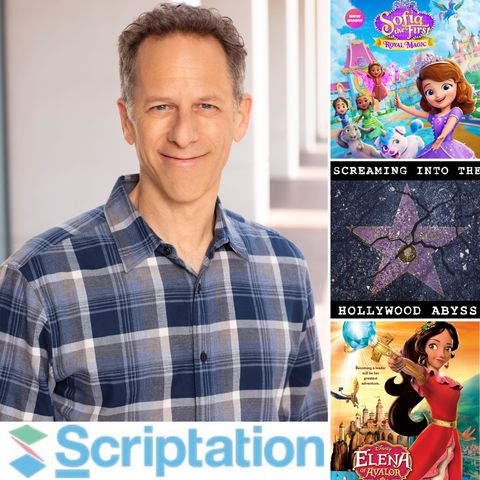
Take 154 - Showrunner and Creator Craig Gerber, Sofia the First, Elena of Avalor

 Apple Podcasts
 Spotify
 Podchaser
 RSS Feed
 A true fairytale today as we talk to Craig Gerber, creator of Disney princess shows galore.
He tells us his fascinating tale of fairies that led him to create Sofia the First while stuck in a traffic jam, the joy of working at Disney and presentation and diversity in writing rooms.
He talks about his early career struggles, creating the new Sofia the First: Royal Magic show and what next for his writing career.
A heartwarming tale of success in Hollywood articulately told.
Any of us who've been in it for long enough, our entire career has been littered with jobs that we didn't get, projects that we thought were gonna go for shore, dozens of unproduced literature.
SPEAKER_04All of us are running into both major and minor failures in Hollywood every single day.
SPEAKER_03This is one of the only businesses I can think of where failure is real light.
SPEAKER_00As ever, I am Dan Rutstein, your non-entertainment co-host.
SPEAKER_05And I am your still in the entertainment business co-host, Noah Epsilon. On today's Screaming Into the Hollywood Abyss, I'm thrilled to introduce TV writer and showrunner and show creator Craig Gerber. See, I trust Craig Gerber to the podcast. Craig is the Emmy Award-winning writer of Sophia the First, Firebuds, Elena of Avalor, amongst many others. His new series, Sophia the First Royal Magic, premieres May 26th on Disney Plus. Welcome, Craig. I pronounced it correctly, and then I thought in my mind I had pronounced it incorrectly. But anyways, welcome to our show.
SPEAKER_02It is Gerber. It is Gerber, yeah. But I thought I heard Gerber, but maybe it's a Gerber incorrectly.
SPEAKER_00So we are in the show. We are not redoing this.
SPEAKER_02Um this is what it's about. This is why I'm excited to be here and thank you. Thank you both for having us.
SPEAKER_05Um let's I'm gonna start again.
SPEAKER_00No, you're not. We're gonna continue. This is the magic of magic of television covers up so much stuff, and I think it's important for the people who listen to this podcast to really understand what can go wrong in live shows. So um, I think we'll continue as we are.
SPEAKER_05And no, let me embarrass at least correct. It is Craig Gerber. Uh, welcome to the show.
SPEAKER_00All right, thank you. Apologies for uh the rejection, failure, and adversities of our podcasting. Um, so what I was about to ask was um this is a obviously a podcast about rejection, failure, and adversity. Now on paper at least, here you are, a man who has created a wildly popular show on one of the largest and most important streamers as part of one of the biggest companies in the world. You've won awards. Why are you on this show? Shouldn't you be on the show that's just about really successful people?
SPEAKER_02No, I it's important I'm on this show because you know, prior to this moment or the the past, you know, handful of years, I had, oh, I don't know, nearly two decades of struggle in Hollywood and varying degrees of middling success, but not really leading up to this. So that's why I was very excited to be here because when I heard that there was a podcast about rejection and failure in Hollywood, I said, Well, I have I'm the one who should be on that show because I have as much as as anybody up to a point. And then it all worked out fine.
SPEAKER_00So look uh there's a joke I can't work out what the joke is about should your show have been called Sophia the 37th rather than Sophia the First, given how many versions of it probably didn't work before you got it right. But let's because I can't work out how to tell that joke properly, let's go back to the beginning. So this two decades of of struggle is the bit that we're fascinated in because you obviously wouldn't have achieved the success without it. Tell us what what does two decades of two decades of struggle look like and and feel like?
SPEAKER_02Uh it didn't feel great at the time. Um, I can tell you that. Um I went to um, I mean, uh without going into my whole life story, I was I was born in New York and and as a young kid moved across the country to to multiple cities very quickly, land and wound up in Southern California and uh eventually went to um USC film school where I studied to be a uh you know live action feature screenwriter. And interestingly, had had you know a little bit of success right out of the gate in the respect that um, you know, there was a showcase, my screenplay was in it. I I was signed by an agent right out of school. They um got my first, the first script I ever wrote optioned by these indie producers for no money, uh, you know, one dollar, and they had me rewrite it uh for two years just about, and then they set that up at uh Disney. And, you know, at the time I thought, wow, that's amazing, you know, here we go. But no, that was just the beginning of the struggle. You know, um in that particular instance, you know, I I was technically hired to do a rewrite that they wanted no part of me doing it. So they just paid me off, had other people develop it into the ground, and that kicked off many years of really being a feature screenwriter in Hollywood, writing specs, trying to get them optioned. Um, for many years. In fact, I wrote starting in like my sophomore year of college, I wrote at least one feature script a year, every year, um like for 20 years. And and and some of those scripts eventually were for hired. You know, that was paid to do it. Um, I eventually got to the point in 2004. I had gone through multiple agencies, many, many specs, some optioned. One of them went all the way up to the top of the studio chain. It was like a big spec, you know, it was when specs were really going in the 90s. And, you know, mine was being brought into every studio by multiple producers, and you know, it was going up through the development executives to the VPs and then up to the people that really decide and didn't sell. And then that was that was in the late 90s, and then fast forward to 2004, I finally had been just working and working and working, and then wound up being signed by some agents at what was then called Endeavour. And it was fascinating because I was the same writer, but I the agents were able to get me into rooms where I could get jobs suddenly. And so, you know, weirdly, after what was like 12 years after graduating from college, I was then a WGA writer, working consistently right up until the writer's strike, which was only three years later. And so I was still on the way up. I was still like getting things, yeah, I was getting jobs, I was being hired, things were optioned, things were on their way to be produced, which I can talk more about if you want. And um, and then the writer strike happened and the economic downturn after that, and that pretty much changed everything.
SPEAKER_05Right. So fascinating. I moved to Hollywood right during the that writer strike. I was, you know, part of different websites uh that were kind of you know talking about the strike. I was at the time they didn't call it that pre-WGA. I was really excited to like pick it with the WGA writers, and we moved to Hollywood the day I moved. Actually, I was on the airplane or getting off when I got a deadline from the Nikki Fink, when she still was, you know, there saying the strike was and has had ended. I I, you know, I credited myself for arriving at the right bringing the right energy to Hollywood that ended that strike. Uh, but I was taking meetings at that same time uh a little bit later for features as well. And I was told really quickly there is no money. Like the feature business has cratered completely. Uh, you should try to focus on on television. But you know, we're here to talk about your stories. So I was just kind of curious in that time period or leading up to that time period, right before you clearly made a massive pivot. Uh uh, what was your biggest heartbreak?
SPEAKER_02Leading up to that point. Yeah. Yeah, there was um one script in particular, and it was the script that got me signed at Endeavor. And and um and probably my I mean, other than scripts that had been optioned here, that you know, that first script that was optioned, you know, um this one again came close to selling as a spec, but didn't, but uh got optioned by this producer, and we were working on it. And we attached this up-and-coming director, um, who is a protege of David Fincher, very nice guy, very talented guy, um, hadn't directed a movie yet, was looking for his first feature, came on board to, you know, direct my script. And there was this moment in time where uh a division of Universal had a slot to make this movie. They had the money to make an indie film. They liked this director, they wanted uh Platinum Dunes, which is Michael Bay's production company, to produce it. And but this one producer I'd been working with still had the rights to it for like another month. And uh during that summer, and my agents at the time were telling me about this opportunity. We have this, it could be a Go movie, this director who was attached and that, and and the studio and everything. And they just needed, they just didn't want the producer who had the option to produce it. They wanted to pay him six figures to not do it. And they told me about this a month before the option ended, and I said, You guys just gotta wait. You gotta wait, don't do it. I've been working with this guy for like a year. He's a huge ego. He um he had a situation happen on a previous project where he was paid off to not produce it and was bitter about it. And I'm like, and I'm I I said to him, I'm like, he won't, he's not gonna go along with it. And they did it anyway. And not only did he not go along with it, but because they had shown it to somebody without his approval, he threatened to sue everybody. And the whole thing fell apart. We couldn't do it because we were gonna, you know, there would be a lawsuit. And that director was Joseph Kaczynski, who went on to direct, you know, um, many movies, including Top Gun Maverick, and and and is a fantastic director. And so that I think that was the biggest heartbreak up uh yeah, through that point.
SPEAKER_05Okay, so then explain to me the pivot. Like what what what what made you and by the way, it doesn't sound like Joseph Krasinski is the type of person to make a movie about uh uh uh animated princesses. So you clearly not only pivoted genres, you pivoted maybe styles as well. So I'm really curious how you got how you you know came into the world of Sophia the first and and you know created a monster show to series.
SPEAKER_02Yeah, that's really funny. I I neglected to mention that, you know, I primarily wrote dark uh supernatural thrillers, or that particular script was a psychic thriller, type of cross between scanners and three days at the condor, because I love those paranoid thrillers from the 70s. Um the first script that got optioned was like an adventure period piece set during World War II. So it was nothing like what I wound up doing. But I always loved animation and I couldn't, you know, I didn't ever think I could work in animation because of just the nature of how it was made uh in Hollywood up until Pixar. And when Pixar came on the scene, it it really became more script-driven than it had been. And I remember seeing Finding Nemo in the theater and thinking for the first time, oh wow, I could actually do this, you know. Um, I could, because I could I could see it, the screenplay, as feeling like a uh a screenplay, a screenplay that a live-action screenwriter would write, or that any feature screenwriter would write, as opposed to uh animated movies, which up until that point were really built in sequences on boards, and so was was more storyboard driven than script driven. Um, all that is to say, after the strike, as you noted, there wasn't much going on in features. Development was slashed. There was, you know, I had a project set up with production companies that had their own funding, their funding was gone. So there was this moment, and and this is really where the theme of this show comes into play. There was a moment in 2009 that I distinctly remember I was having dinner with an old high school friend, downtown LA, and my agents called me because it was uh and I walked outside and they were then they'd merged into William Morris Endeavor. And after the strike, there were a series of purges where they were purging their clients who'd weren't bringing in enough money. And I had survived one or two, and this was the one I wasn't going to survive. So I'm standing there on the sidewalk taking this call, being dropped by my agent. I have one one-year-old son, I have another one on the way. Uh, and I am thinking to myself, what am I going to do now? Um, everything was dead. All my projects were not happening. And so around that time, this person that I've known, I'd known for a long time in Hollywood, who would never hired me for anything, was working at Disney in a division called Disney Tune Studios, and they were doing the Tinkerbell movies, which were direct DVD movies in the States, but were uh theatrical abroad internationally. And a lot of people don't know this, but this division, even though they were making DVD animated features, uh, it was overseen by Pixar. It was all everything Disney animation was overseen by Pixar and John Lassiter because he loved animation and he wanted to be have his hands in everything. And so the reason I bring that up is because my friend called me and said, Look, we need someone to come over here and tie together all the mythology of the Disney fairies, right? Because they were making these Disney fairies movies with Tinkerbell, but they also had the Peter Pan movies and they had this series of books that came out in the 2000s that were completely different. And so there were all there was all this different mythology. And my friend knew that I was really good at world building because in my screenplays, one of the things I did a lot was build fantastic worlds, whether they were supernatural or science fiction. Um, you know, I had an affinity for that. And so he brought me in, and it wasn't even screenwriting. They brought me in to create, uh, to tie together this mythology. And I wound up creating basically a franchise Bible, um, where it somehow all made sense. I put everything on a timeline. I made a, I made, I learned how to make a book for for this. I made them a bound book called the uh the field guide to Disney Fairies. And it was so important to them that they actually had me pitch this to John Lassiter himself, uh, as well as uh the man who was in charge of Disney feature animation. We were all in this room, and I had to basically say, so this is how the Disney fairies work, or they could work. And because he liked that presentation and how much work I put into it, uh, they let me write a few animated shorts. And that turned into me writing um like a 20-minute short for them, and then writing uh an animated feature for them. Um, or at least I wrote the drafts that got greenlit. And then there was a way that things worked over there where you would you were a staff writer over there, they would move you around. So, you know, um, but I was having a lot of success suddenly in this animated world, and it was really fun. But the thing that I really want to emphasize here is that the first thing I did when I got there, this the series Bible felt like 15 steps backward. Like it would did not, it felt like I had been a working screenwriter, and here I am suddenly not doing screenwriting. And what is going to happen? You know, how is this going to lead to what I wanted to do? And the interesting thing was is because I I'd loved animation my whole life, and because I'd spent so much time working on my craft, uh, when I had that opportunity to pivot and write for animation, it all the tools were there for me to flourish. And because I was in that spot at that time, they introduced me to someone over on the TV side at Disney Jr. who said to me at the time, and this is still in 2009, right at the beginning, where I basically I made this book, I ruined my eyesight because they loved working in the dark. Some I ruined my eyes forever. Um, and I um I'm making a book, which is weird. And then this this woman named Nancy Canner, who was running Disney Jr. at the time, said, if you ever have an idea for an animated show featuring a princess, a girl girl princess, because you want to do a show about girl princess, no one can crack it. If you have an idea, feel free to come and pitch it. And uh, and at the time, I'm like, well, I mean, um, yeah, I'm not doing it, I'm not doing anything else. So let me give some thought to this. And and I was stuck in traffic one day on the freeway, driving home from this job uh where I wasn't screenwriting. And yet I would be soon. Um, and uh, you know, I was right by the Disney Animation Building, and that's when I came up with the idea for Sophia.
SPEAKER_00Unbelievable. So uh as Noah likes to say, we might we're I think we're like 160 episodes into the podcast. That's one of my favorite uh stories. The fact that this is this remind it's not the same, but this reminds me, I can't remember which Noah will remember which guest. The person who was who went to Family Guy tried to deliberately fail in his um because he didn't want to work in some silly animated show that he didn't understand, and it ended up being the you know, the best he thought it was a career step back and it ended up being the opposite. I I love, I mean, obviously, this is a bit different because it's with Disney, but the fact that you were doing something which was taking you in the wrong direction, and then ended up this place is in a world where horrible things happen to lots of people, and you know, relatively in the world of entertainment, this is a lovely, heartwarming story.
SPEAKER_02Um I I thank you. I I remember I remember being in that room. It was at Disney Teams Studios, and because they remember Pixar, they also like brought in a lot of um people talk about writing. They do this at Pixar too. They really think about story a lot. It was kind of like going back to film school, and so I was already sort of humiliated internally that I was not screenwriting. And I'm and but I because you know, the one thing I never stopped doing was writing and working on the craft and trying to learn. And so they brought in these people. So I'm like, yeah, tell me about it. Tell me more about writing, tell me more about structure. And I learned a lot being there. I learned a lot by not really by swallowing my pride. And and there was that moment I'm sitting there at one of those seminars, and there was someone from Pixar Development who was talking to me, and they're like, Oh, yeah, so you're you're kind of like a dramaturg or something. Or they were talking to me about like what I was doing there. And that's cool. I've known people like that before. And I was looking at her thinking to myself, internally, no, I'm a screenwriter. What do you what? Yeah, but I could, but you know, it's I that wasn't the moment to say that. That wasn't the moment to say kind of try to, you know, plead my k ego case. So I just, you know, I learned what I could, and I I tried to make the most of that opportunity. And one of the interesting things about the development of Sophia is that at every moment along the path of that development, I thought they were gonna say no, there is no way in the world we're gonna do this. You don't know anything about television, you don't really know that much about animation, and um and I thought it was gonna die at every single step.
SPEAKER_00Amazing. I it sounds like a rare case of good things happen to good people, which is normally the opposite of how Hollywood works. So tell me about the I actually I I I remember asking this question the other day of someone actually who works in Disney animation. Um James Easton Garcia. Um but I I've been to the Disney lot lots of times um for screenings, I had some meetings with some of the Disney technology people in an old job, and every time I walked onto that uh place and you just feel like you're somewhere special. When you went in that first time, and then actually in in the hundreds of times you've been there since, does it still feel like something special to you?
SPEAKER_02It actually does. Um I mean it's it's still a corporation, and there are things that you have to accept with that, you know, in terms of the business side of things, right? And anyone that's g you know, sort of g gets into that sort of executive producer space, you know, that's part of the job, right? You're you're you're you're managing being a a a bigger cause. In the machine. However, the wonderful thing about being at Disney is this the people, and it's especially true at animation, the people that are there believe in the legacy of what the company has done artistically. And there have been many, many times when I've had to lobby the people I work for to do something a certain way, or or or spend a little more time or effort on the animation or or or some other aspect of the show, or something I want to do creatively. And I will say, you know, this is the kind of thing that Disney is known for. They people expect Disney to provide a certain type of storytelling. And that that lobbying wins the day a lot of the time. So yes, it does kind of feel special because there is this sort of this sort of tradition. And the people there are really trying to sort of stand on the shoulders of those giants and and do something, you know, as great, which is kind of cool. Right.
SPEAKER_00It's now his turn to ask a real question, but I have to, I've got a slight obsession with this. Um, so I have to ask you, have you been to Club 33?
SPEAKER_02I have once been to Club 33. Uh uh, it might be my my boss at the time, that was that was um Nancy Canner, because she was the one that really championed Sophia the first. I give her a lot of credit for everything because she the stuff, the way I was doing creating Sophia, it didn't really look like anything else that was in the preschool animated space at the time. Because what I was trying to do was take all the stuff I learned as a featured screenwriter and sort of push it into a TV show. Like, hey, let's give kids a Disney princess movie on TV every week in 22 minutes. You know, it's kind of ambitious in a way, and she was like on board for it, and she really pushed it through the system. And so when it turned out to be a real big success, she did once take me there. Uh, and it was it was great. I'm not gonna lie, it was fun.
SPEAKER_00It's it's ridiculous. I was invited there 10 years ago, maybe 11 years ago, and I didn't go because I didn't know what it was, and I've been regressing it ever since. It's crazy to me that you can have created a show for Disney and you've only been to Club 33 once. It feels like you should have a gold pass that gets you in forever. But anyway, sorry, no, it's like it's worse than that.
SPEAKER_05There is Sophia the first merchandise all over uh Disneyland, um, if I remember. The the uh Dan, you and I have been to the opposite of Club 33, which is eating turkey in the rain in at Disneyland while it was like pouring mud on all our food. So so whatever the opposite of Club 33 is, that's what we got to do when we were there. Uh the uh peeling back the layers of our relationship here in this podcast. The um, so you know, I'm curious because a lot of people are going through really hard times in Hollywood right now. And it's, you know, when I look back upon my career and through the times where I wasn't working versus I was working, and I was like, had I known at that time that this opportunity was coming right around the corner or this thing was leading to that thing, and I just didn't know it at the time, I wouldn't have been so stressed out. Now, granted, a lot of people, you know, never find work again. So it's not always like there is work around, you know, that's gonna come to you. But what what would you tell, what would uh, you know, Craig Gerber today tell Greg Craig Gerber from the past, living in that moment, writing that book, probably with a wife asking you, you know, being supportive, but hey, hey, we got we got a kid and another kid, like are we gonna be able to do this? Like, what would you tell that Craig today, you know, if if if you could have a conversation with him?
SPEAKER_02Um what would I tell him? I mean, I could try telling him not to stress out so much, but I'm me, so I know that wouldn't work. Like that's just you're gonna be you, no matter what you're you know, what you do. But I would have said, I would have died, I would have gone a couple things I would have said to my former self is, you know, and this is sort of a creative thing. I I I feel like I should have this could predates the Sophia stuff. I'd never I should have picked a lane of something I really liked and stuck with it. I would have saved some time. Um, I you know, you you there were I kind of danced around genres. I kind of let the story motivate what I wrote. And as a result, I would meet a lot of people that would then not be the right person to go to for my next script. That's just something I think, just from the craft or being in Hollywood. Like I I I watched a lot of people um go through the graduate writing program at SC, become very successful very quickly because they married what they like to do with something they could sell. Um, and and then as and then just pounded it until it worked. I know that doesn't speak to necessarily sort of that point at which things changed for me. Um, but I do think that it's important to kind of find something you love and then really hone it, hone that craft. Uh I think I mainly I would have said, you know, don't be so hard on yourself for the things that you might do along the way that you don't think are the right thing. You know what does you know what I mean by that? Like, oh, if you're I mean, there was a time where TV writing was looked down upon by a lot of feature writers. That's not the case anymore. You know, but uh, but but as I was, there was a time when uh the there were there were the writers and development executives, and I kind of lived through the time. This is before you got out here, Noah, I think, where a lot of development executives became screenwriters. And, you know, I had an opportunity back in the early 90s to become a development executive, and I turned it down thinking that would put me on the other side. When in fact, I would have learned what was selling, why it was selling, I would have read a ton of screen plays, probably learned more about how good writing works, and then would have known all the right contacts to send my scripts to. So, you know, there's like a lot of, I think that the big thing is being open to the unexpected and keep working on your craft.
SPEAKER_05Yeah, it's really hard. No one besides maybe your USC, the graduates from USC who hyper focused, it's been really hard for anyone that I'm that I know of this business to actually like pick a lane and then have that lane work out for you exactly the way you planned it. You often get sent like, whoa, you're working on these procedural shows. Yeah, but I don't actually write. That's just what I that's my credits, but what I actually write. But so speaking of that, uh, you know, you've been doing Sophia the First and Disney princesses, uh, with some exceptions, but in the sort of Disney animated world for a long time now, with a tremendous amount of success. Is there a version of you sitting in that beautiful office or an office that predates that beautiful office that you're sitting in right now that is still writing these darker psychological dramas that you're hoping, you know, Joseph Krasinski will uh direct one day, if you could just just you know, not get him to read it, because I'm sure you can get people to read it now, but just, you know, are are you are you still focusing on other sides of your career? I guess is the question.
SPEAKER_02I I be honest, I haven't had the time. Um to there is, you know, there's there's that yeah, I started out a feature screenwriter and and have I've been at Disney for quite some time now. I've been in production since April of 2011. So that's 15 years. I haven't not been in production. All my shows have overlapped. So there's been no hiatus because it's all year round. Um, and that's very fortunate. I'm very fortunate to be in that situation. The the reason I'm in that situation is because once Sophia went and I recognized this is the opportunity, I would start developing the next show before the show ended. And that was a lesson I learned from my old endeavor agents. Once I had I'd booked my first dig writing assignment and I'm working on it, and I want to make the best script ever, right? I'm like in it. And they're like, we want to set you up with this guy to get this job. And I'm like, no, no, no, I don't want to meet about something else. I gotta, I gotta make this great. And they're like, no, you got to get your next job before this job is done. And at the time I was like, but if this isn't good, how am I gonna get the next job? But they were 100% right. And so all my development has overlapped, and luckily the shows have gone, and that's kept me employed. At the same time, I've you know done other development for Disney and other divisions. You know, I wrote like a live action TV pilot for them. I wrote a couple of um live action movies for Disney Channel that didn't wind up getting made, but you know, I worked on them through this. So I've been able to use that muscle, I guess, or flex that muscle, I should say, to some degree, because it is still uh Disney and family oriented, right? It's not as as dark as the other stuff I've written. Um, but you know, I had to make that decision really that I was going to make that trade-off. And and luckily, I was able to make shows that are very creatively satisfying. The storytelling, um, the different genres I get to bounce around because of the way Sophia and Elena were structured. I could do different types of episodes, like adventures or farces, or sports movie, or like a kind of friend version of a rom com, right? Like there's a lot of different types of storytelling I could do. And uh because that's been so rewarding, I haven't felt the dire need to go go and do that other thing.
SPEAKER_05That's a great answer. And I do want to add that today is my day of butchering names, it's Joseph Kaczynski and it's John Krasinski. I just want to, Joseph Kaczynski, who I'm a big fan of your work. If you are listening, I do know how to pronounce it uh correctly pronounce your name. Now throw any questions today.
SPEAKER_02And you know what, real quick, just because we were talking about him, um, talk about good things happening to nice people. One of the nicest people I've ever met in this town was was Joseph Kaczynski. He was so incredibly nice and so easy to work with. So I was so happy for him when he his career exploded.
SPEAKER_00And yeah. Um we love you, Joe. Jumping around the timeline, I guess, a little bit, but you referenced a conversation where you were told that if you could come up with an idea for uh a show, you know, they would be interested in it. And you said you came up with it while driving down. Was it the 405, the 101?
SPEAKER_02No, it was the 134 because there'd be a lot of traffic in between. You're like right by that Disney Channel built by the uh the animate, the hat building, as they call it, which is the big, you know, sorcerer's hat above the animation building.
SPEAKER_00So I guess my question. So I ask two questions. One's actually not really for this podcast. It is just like, how did you come up with the idea? I'm just I'm interested, even though that's not not what we normally do. But the one that's sort of more for us is um you know, was it literally your first idea? Or, you know, were there three others that didn't quite work? And maybe was one of them secretly better, but just never worked out.
SPEAKER_02You know, it's very funny. It's it's one of those weird things. Look, I spent, I have what, like, I've got to, I mean, I I told you I wrote like over 20 scripts. I like at least 15 of those have to be unproduced specs that I just wrote that never saw the light of day, right? So ideas that did not make it. This idea for Sophia, like it got developed, but I I started out saying, okay, I was I was like, what? I had a one-year-old kid, he was gonna be watching TV soon, not yet. What would I want to watch with him? And I was just thinking about concepts that would be fun to do. And and the idea, the initial impetus for Sophia was I wanted to do sort of like an enchanted royal Brady bunch, where there were step siblings and they had to get along and they were from different families. And I pitched that, and then that as we were developing it, it became it's a girl from the village who become who mar whose you know, you know, whose mom marries the king, and that and that was our way in to create a fun fish out of water story. Um, and it but it it started from me thinking about like great television shows and what kind of fun play on the the Disney princess world I could do that would be like a really good dramatic story engine. I really, to be honest, I came at it from sort of like a I mean, you could you would say a feature or even a TV place now, right? Like, like what kind of um fun premise could I could could create a lot of interesting, emotionally compelling stories, and we could have a lot of fun with it. So that's really where it started. And it was that idea. I mean, that idea morphed, but it was basically that idea, and there were no other, it wasn't like I had three ideas. That was it, that was the idea for that.
SPEAKER_00Yeah. This is a I'm not sure this is a very good question, but I'm gonna try it anyway. And because I edit and no it doesn't, if this doesn't work, I'll take this out in the way that I refuse to take out his intro. Um, so uh obviously this was 15 years ago. Um in over the last five years, maybe there's been a big push for I guess authentic voices, as it were, in the sense of um, you know, when Moana 2 came out, the people who wrote Moana 1 weren't allowed to do Moana 2 because they weren't coming from the right place. If if your show hadn't been created where it was, and they were somebody wanted a story like that now. Obviously, I know there aren't actually any princesses out there, so you can't get authentic in that sense, but would a would a middle-aged man be able to write that, or would it have to be pitched, do you think now differently by obviously not a princess, but maybe a female?
SPEAKER_02Or I mean it it depends on I mean, it depends on who you're pitching it to and what the circumstances are. Uh when I was you know, when I was doing Sophia, that's when the idea for Elena Vavalor came along. And she became Disney's first Latina princess. And, you know, they I had it, I had an idea for it that they loved, and I had the experience at that point to make the show, and it was a very important show to the studio. But I recognized that I was not the most authentic. Like I'm like, like I shouldn't be telling that story from my perspective alone. So I made sure that, you know, the head writer of that show was Latina, and I made sure that we had a very diverse crew with a lot of perspectives that would bring that authenticity. But it was a very ambitious show, and it was a very hard show to do. And so, you know, had there been someone with the that could bring the authenticity and the experience of making an animated television show at Disney, you know, that could do that. No, they probably would have had that person do it. But at the time, there it it worked out that I was there for my experience and storytelling and my, you know, my ability to push something through the system. And I just I brought on people that were key collaborators that brought the authenticity. And to go further with that, what I found out over the course of working on um Sophia and Elena and Firebuds, which also had a diverse family at its core, um the the his there's a huge pool of writers that want to do features and a huge pool of writers that want to do live action television. When you get into animation and then you get into preschool animation, the pool of people who want to do it gets smaller and smaller. And so the pool, the pool, there, there just weren't enough diverse voices that wanted to do it that were doing it, that were doing it well. Just like the numbers game of Caucasian male voices, right? When I was staffing up Sophia, it that was a primarily um, there were primarily female writers in the room. That was a largely, there were largely women in the room. They were the best writers that I could find. So, you know, there just wasn't a big pool to choose from. So one of the things I was trying to do was bring people into animation that were diverse voices that may not have been thinking of it to increase the pool of talented folks doing it. And and I was able to, so I've been able to do that as the shows have gone on, and and I think it's been great for my shows and is great for animation.
SPEAKER_00Yeah. Thank you for a very thoughtful and considered answer, which makes that actually look like a reasonable question after all. So thank you. I hope it made sense.
SPEAKER_05No, I didn't get to your your answer made Dan's question sound good. Um the the the okay, what is we're we're heading to, you know, we're at the tail end of our podcast. We only have time for a couple more questions. So I'm gonna cheat and do a two-for-one question here. Uh, what is your absolute worst Hollywood experience? And conversely, what is your absolute best Hollywood experience?
SPEAKER_02Um that's a great question. The the I think the the worst experience that I can remember is tied between the pitch I had where the exec was bouncing a ball against the wall the entire pitch. And it was just generally rude the whole time for no good reason. I mean, I didn't even pitch my idea. It couldn't even be like your idea is so bad you've wasted my time. It started out with me wasting his time. And and the other bad experience, ironically, was before all the stuff happened with with Disney Toon Studios and Sophia, I had one of the worst pitches of my life at Disney Feature Animation. I just remember just from the moment I started talking, it was going downhill. And uh and I was just, and I thought, well, I'll guess I'll never work in animation again or ever. So that was a big irony there. Um the best experience. That's tough. That's tough because it would be, and maybe I think writer, see, there's a best writer experience, right? The best writer experience I had was like when, you know, when you have the answer in the room, when someone's talking to you about an idea, and like I was talking to one of the executives about what would eventually become Elena of Avalor, and I came up on the spot with the core concept of what that show should be. And I was, you know, for for a writer who, you know, you're not an actor and you're not a performer, and you're you could relate to this probably. You're not, I'm not quick, right? I'm not quick. I'm not, I don't feel like I'm clever. And on the spot, right? I have to write clever, like spend a lot of time getting to it. Uh, and I felt like I had it. I had the idea, I had what became the sort of theme of the show. Um, so it'd be a tie between that and then like maybe being at that Sophia the First premiere, where there was this huge event, and like my show got made, and it was my thing that I created. And that was really kind of wonderful. And I was there with my wife and my children, and and that was just a wonderful moment in time.
SPEAKER_05Oh, that's awesome. Uh, thank you for both all of those stories, all three of those stories. Uh okay, so this is our very final question. This is something that we ask everybody that comes on to our show. If you could give one piece of advice to somebody joining the business, uh, in this case, uh either at in in animation or just in you know screenwriting, what would that be?
SPEAKER_02Just one piece of advice. One piece of advice. I you have to keep plugging away at it and hope that eventually luck will find you. That is the best I can. There are a lot of things to add to that in terms of how to take notes and things like that, but really it boils down to you just gotta keep keep doing it. And and you know, eventually you will find your way. It may not be what you expected, it may come from an area you you never thought you'd go down, but that area could be the most rewarding thing ever, but you absolutely have to keep working on your craft so that when that moment happens, you are prepared to take advantage of it.
SPEAKER_00Yeah, that's right. That's much better framing of my good things happen to good people. Yours makes much more sense. Um, uh Craig Gerber, uh, as professional podcasters call you, thank you very much indeed for coming on the show. It's been genuinely absolute pleasure to have you on. Really interesting answers. And I I won't forget that story um that you told. It's just such a a great way in to Hollywood with you know 150 episodes of some pretty horrific stories. It's it's nice to find a bit of a literal fairy tale.
SPEAKER_02So um it's great. Thank you for having me, and it's been a pleasure sharing my tales of failure with you today. Thank you. Thank you. Yeah.
SPEAKER_05Thank you so much for listening, and thank you, James, for the music. And our live.com today. As always, each episode is brought to you by Scriptation, my favorite screenwriting annotation software. If you want to support the show, please download a copy at www.scriptation.com.
SPEAKER_00Or perhaps even better www.scriptation.com.
SPEAKER_05If you want to find me on social media, I'm at N Epson, and more recently, I'm friends at no episode.