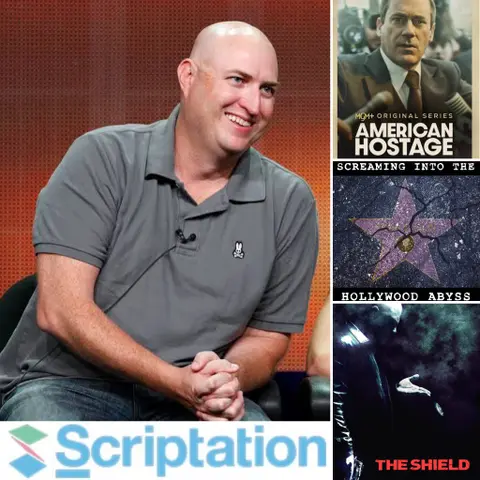
Just keep writing. Showrunner and show creator Shawn Ryan, of The Shield, American Hostage (co-creator) and so many more

 Apple Podcasts

 Spotify

 Podchaser

 RSS Feed
We have the youthful Shawn Ryan on the show.
The legendary showrunner tells us about translating what he learned from school sports into Hollywood work, working on Nash Briges and the varied skills needed to succeed.
We talk about how streaming changed the industry, using podcasts as source material and he gives great advice.
As humble as he brilliant, a great episode with one of the best to do it.
SPEAKER_00
Any of us who've been in it for long enough, our entire career has been littered with jobs that we didn't get, projects that we thought were gonna go for sure, dozens of unproduced scripts littering the floor.
SPEAKER_01
All of us are running into both major and minor failures in Hollywood every single day.
SPEAKER_02
For every success, there is months, sometimes even years, of hype failure.
SPEAKER_03
This is one of the only businesses I can think of where failure is the default. That's the norm. You have to be able to persevere.
SPEAKER_04
Like everything in our business, your hands can count. it all bounces off you. Uh you know that process takes years. That doesn't happen overnight.
SPEAKER_00
I was being told by my manager it's yours to lose, and I promptly lost it. And I remember thinking, like, well, that's it for me. I blew my one big shot. What I've realized from that moment is it's never one big shot. There will be other shots.
SPEAKER_02
Welcome back to Screaming Into the Hollywood Abyss, a podcast about rejection, failure, and adversity in the entertainment industry, brought to you by the Emmy Award-winning annotation software scriptation. As ever, I am Dan Rutstein, your non-entertainment co-host.
SPEAKER_01
And I am your still in the entertainment industry, co-host Noah Epsilon. On today's Screaming Into the Hollywood Abyss, we have TV writer, showrunner, and show creator Sean Ryan on the show. He was a writer on such iconic shows as Nash Bridges, Angel, before creating, showrunning, andor executive producing such shows as The Shield, Chicago Code, Last Resort, Timeless Swat, The Night Agent, and American Hostage. Welcome, Sean.
SPEAKER_06
Thank you so much. Appreciate it.
SPEAKER_02
I think I've said this a couple of times recently when we've had guests like you on. You've got an unbelievable body of work with some incredible shows that are absolutely beloved. But nothing can be that simple, surely. So let's start with, and this will probably be the only time somebody with your success gets asked these sorts of questions. Tell us about your single worst experience in Hollywood in terms of a failed pitch, a job you got fired from. Let's start from your from your low point, and we can do the the good stuff later.
SPEAKER_06
Sure. So uh I came out here and uh to Los Angeles in 1990. Um I had won a um a playwriting award um through Columbia Pictures Television for best comedy play in the country. And so for a long time I thought I was supposed to be a comedy writer. Um before I kind of uh took took my crack at drama instead. Um and I've been out here a few years. I'd written a number of spec scripts. I had been able to get a manager. Um and for the first time in my young career, I was uh um I was getting a few meetings, I was getting a few stabs at uh at being hired. Um and I was living in a studio apartment in Hollywood on Beachwood Drive. Uh remember, uh, you know, a studio apartment, no bedrooms. Uh, and I would oftentimes have roommates to to you know split the uh expenses. It was $550 a month, I remember. Um, and I and so I was getting by, making like maybe 10 grand a year. I was uh you know doing various odd jobs and I was tutoring math. And um, and so it was really like it would be it would mean the world to me if I could get even a freelance job on one of these shows, or if if oh my god, if I could get staffed. So I remember um I remember getting getting a call from my manager that they wanted to meet me on on a show. Um you may have heard of it. It was called uh Boy Meets World. Um and it was a popular sitcom in the 1990s. And I got very excited, and I'd seen a few episodes, but not a lot, and I did, you know, I did as much research as I could. It was harder then, you know, not every episode of television and history was readily available to you on some streaming site back then. So, you know, you know, I was trying to get videotapes of episodes and trying to really understand uh the various characters and and everything, and and um, you know, went in very prepared. Um, and it was one of the odder meetings I'd had in that there were maybe like eight or nine people in the room. You know, usually you're meeting with one or two people, the you know, the bosses, the showrunners. And in this case, they had most of the writing staff there and um and the producing director there, and we were talking about the show. Um and you know, I was making my case, and and the main boss, whose name I don't even remember now, um at the end of the meeting, he said, Well, listen, you know, so-and-so over here has read your script and really loves it, um, but the rest of us haven't read it yet. And all we're really concerned about is really just finding the best writers. Like it's all gonna come down to the writing. So the people that we're meeting with, we're gonna, you know, trade scripts around and we're gonna read the scripts, and we're just gonna hire, you know, the person, you know, with the best writing. And I said, you know what, you can't ask for anything more than to be, you know, judged by your work. And I I appreciate you taking the time and thanks so much. And so that meeting was at Disney. Took me about 15 minutes to drive back to my apartment. I was like, okay, I feel good about that script that the one guy read and liked. And and you know, they'll probably take a few days, a week or so to sort of read. Um, and I got back to my apartment 15 minutes later. I called my manager, updated the meeting. He goes, Oh, they called, they passed on you. And I was like, Oh, I got this big speech about about how they were gonna take the time to read all these scripts and everything, and they must have just like hated my personality. Um, so I'm not sure why I got that big sort of thing, but that was uh that was one where I was like, well, I get you know, get ready to go back to my day job, I guess, uh, and uh, you know, have to paw through that one. So I remember that day pretty specifically and and thinking, oh well, that's how Hollywood works. They'll just stare you right in the eye and and sort of say it's it's just gonna be all be about the writing, and we're all gonna read your script and give it due consideration. And no, no, they didn't do that at all. So that's what happened to me.
SPEAKER_01
That's a that's uh amazing story. And I I normally I I want I normally like to stay chronological, but I'm looking at your IMDB and I see Nash Bridges here, and I worked We had John Wirth on the show twice, in fact. And I had I worked for Carlton Hughes on Colony a many a number of years ago, and he'd come in and have lunches with us because he had multiple shows going
SPEAKER_05
at the same time, and it always became every conversation became about Nash Bridges for some reason. Like I don't care what we were talking about at lunch, suddenly we were getting Nash Bridges story. So it's a two-part question about Nash Bridges, and then we're gonna move on to other things. One, how did Nash Bridges get so many amazing writers who went on to having uh like fantastic careers? That's that's question number one. And did you guys know at the time it was sort of like a murderer's row of you guys? And two, I know there's like uh NDAs on top of NDAs. Is there a Nash Bridges story that you can share with us from your time on that show?
SPEAKER_06
Well, I've never signed any NDAs. Um you know, listen, you said the two reasons why they had a great uh roster of writers there. Uh the the reasons were Carlton Keughs and John Wirth. They I think they were just really great um judges of talent. Um you know, I remember uh Glen Mazera and and I both departed Nash Bridges the same year, and I and and and we're both like, oh, you know, good luck to them to you know find people to replace us. And they hired Damon Lindelof, you know. Um, you know, before he was, you know, and and so uh you just have to say that that that they were really good at a spotting people that I think had potential, especially young writers, and then B, they were both fantastic mentors to me. So it wasn't just like, oh, we're gonna hire people, but but they would train you on how to make television and how to write for that particular show. And and that show was kind of famously um chaotic, um, because we, you know, we had a lot of actors on that show um, you know, going going through things and and and a little sort of you know professionally unreliable at times because of things they were dealing with in their life. And and the joke I always used to make was um when when Cheech Marin of uh Cheech and Chong fame is like your reliable go-to steady guy in the cast, you you you know, you have an issue. Um so so yeah, all credit to Carlton and John for one identifying talent and then two, cultivating that talent. Um, you know, and I I wouldn't have been able to do what I was able to do as a showrunner on the shield without those three years working, you know, very closely under those, you know, two very, very wise men. And and and they're both still um dear friends uh uh of mine to this day. Um I really appreciate everything they did. Um what are stories to tell about Nash Bridges? I mean, you know, we were not up on set a lot. That was not uh, you know, we had we had an 800-pound gorilla um star on that show in Don Johnson, who had a ton of power. That show got made because of his name, you know, coming off of Miami Vice fame. I wasn't there the first two seasons, so though I should make that clear. I arrived in season three. Um but uh you know, so I wasn't on set a lot. Not many writers were, it just you know, it just wasn't that kind of show. Um what's a story with you know, um, there were a lot of times where different actors wouldn't show up and you'd be like rewriting the scenes like that morning. You'd be, and by yeah, I mean mostly John and Carlton, where it's just like, well, you know, we don't have you know, we're not sure where Don is at the moment, so let's give Cheech Don's lines and let's give Jeff Perry Cheech's lines, and let's, you know, change them a little bit to reflect their characters. Um so there was a lot of um there was a lot of chaos on the show um up in San Francisco where we filmed. Um and and the only reason why it didn't go off the rails was because um things were so steady under Carlton and John's management in Burbank where we were um where we were writing. Um I will say I I have a story that's sort of fun, I guess. Um I guess was this would have been my last um year writing on the show, um, because uh my wife and I were having a baby, and we had a small writing staff, I think there were only six of us, including John and Carlton. Um and so like every person was important in the room, and you know, but my wife's about to have a baby, and um and uh and so I'm gonna be gone for a little bit, you know. Uh and right before I left, right before her due date, we were breaking a story, and we were really proud in the writer's room of this particular story we crafted. Um, you know, it had some twists, had a good sort of thing, and there was a there was a twist that was a little reminiscent of the usual suspects, in that, you know, somebody who you think is this, you know, sort of unimportant person turns out to be, you know, the the mastermind of things. And so because of that, we would just during the break in that story, we're just calling that character, you know, Kevin Spacey. You know, the Kevin Spacey character does this, Kevin Spacey does this, blah, blah, blah, blah, blah. And, you know, but it was one of those things where like you're making 22, 24 episodes a year, and it's a procedural show, and there's a lot of sort of guardrails that you're operating within. And so a lot of the episodes can feel very similar to each other. And this to us, I think, felt like very um, it felt elevated. It felt like, oh, this, this, this episode's kind of really special for us and and different. And if we can find the the absolute right perfect actor, the, you know, to play this Kevin Spacey role, like this could be really great. And then um, we finished breaking that. And the next day, I, you know, I left and and and my wife um uh we we found out the night before that she was gonna have to go in and get induced because she was having a little medical condition. So I knew when I left work that day, like, okay, I'm gonna have a baby the next day, and I'm gonna be gone for a week or so. And so I left and you know, was just incommunicado. And um and I came back uh to work and I said, Oh, who'd we cast in the Kevin Spacey role? And it was like there was a pause at Pauly Shore. I was like, Oh, well, maybe this won't be the elevated, like amazing thing that I was thinking of when we left. It's like, okay, that snatch bridges for you.
SPEAKER_05
And and was it did it become elevated?
SPEAKER_06
It was fine. It was fine, and and it's no shade at Pauly, but it just, you know, it it it took it on a different tone uh at that point. And and and uh, you know, there'd be a few times where, you know, because we all had high aspirations for the the work that we wanted to do. Um, you know, but there were limitations to that show. You know, we were filming in seven days, we were you know filming in the streets of San Francisco, which was a you know difficult place to film, a lot of you know exteriors, um, you know, a star who and let me say some good things about Don Johnson. Like I was hearing these stories about you know, you never know when Don's gonna show up and this and that. And I and I heard these stories, and then he was coming in to meet the writers at the beginning of a season, and obviously I was new in season three, and he came in, and within 10 minutes, I was like, oh my God, I love this guy. Like, this is the most charismatic person I've ever met in my life. And like he's just charming the hell out of me. And like, like uh, like I just got like starrified, you know, and and things, you know, and and he would show up late sometimes, but then when he kicked in, like, you know, he would he would be free driving this yellow Hemikuda um, you know, convertible car through the Street San Francisco, and and he would know exactly where the camera was, and he would slow down just slightly because he could sense that the camera wasn't getting cheated next to him. Like he he was amazing in so many ways. Um, you know, but but he but he was also the 800-pound gorilla that we had to you know work around and work with at times, and and a lot of it was good, and and and a lot of it, you know, was like, well, where's Don this morning? No, um, and having to like you know work around that. So it was an interesting education.
SPEAKER_02
But obviously, it sounds like you had a you know, used the words education, you had a great education in terms of being on a show like that and then being with some great showrunners and then working your way up. So Noah likes to do things chronologically. I actually don't care for that, so I'm just gonna jump to the bit now where you are a serious person, you've showrun some incredible shows. We talk a lot on this show about the fact that showrunning is uh a slightly odd job, it's sort of five jobs for the price of one. Um what do you think it is that make you a really good showrunner? Is it the writing? Is it the leading? Is it the other people? Like, what's your if you had one thing you were allowed to say about your showrunning skills, what makes you the showrunner that you've been?
SPEAKER_06
Well, I appreciate the compliment in that question. I always think that I'm learning. I don't think I've conquered showrunning. Um, so I I'll start by saying that, but I'll but then I'll accept the rest of your premise and try to answer it. Um one, um you know, I was a joint theater and economics major in college, and I've joked that the only job you can get uh with that sort of joint major is showrunner because there is half a business side, half organizational management side, and then half creative side. Um, but I would say the main thing is just um my temperament. Um it takes a lot to get me upset. I tend to I tend to not get too high when things are going well or too low when things are going badly. Um I've always been a guy who's liked puzzles, and I've learned over the years that um that showrunning is just a series of puzzles that have to be figured out. And that if you approach them that way as a sort of fun exercise of like, oh, you know, um I've suddenly got this issue, you know, where two actors aren't getting along, you know, but they've got to have scenes where they seem like best friends, or you know, or or um you know, we've got an issue on on the crew that's you know getting in the way. Um I don't let it bother me that much. And I say, okay, it's my job to take care of this, it's my job to figure out what the solutions are, and and I enjoy that. So I think um, and then and then I would say I've learned to delegate and and I've learned the importance of um setting a culture and setting a tone. Um, because I learned that when people understand that there are parameters that they should operate and work in and they know what the expectations are, that they usually rise to meet those. I think it's when they don't know what the parameters are that you get bad behavior onsets. Um, you know, if they think that things, you know, if they think that bad behavior will be tolerated, because I think hit Hollywood has a history of tolerating a lot of bad behavior uh on sets. Um, but but if you just tell people up front that, like, well, this isn't the show for that, and it won't be tolerated, you tend to get good behavior on sets. So so I would say that that that part of it's just the way my brain works. Um, I can handle both the business side and the creative side, and then and then a a temperament and an understanding of leadership that sort of came out of um playing team sports growing up. You know, I was a pretty competitive athlete in a number of sports as a kid, um, played soccer in college, you know, was captain of my high school basketball team, you know, was a competitive ice hockey player for a long time. Um, and and I understood that, you know, on some teams I was like the star, and on some teams I was the guy on the bench whose job it was to practice really hard so that the guy in front of me still deserved to be starting. And and I was in all those different positions. Um and and I understood the value of of teamwork, and that's what I preach on my shows.
SPEAKER_02
It's actually interesting. So uh I work in sports and we talk a lot about ex-sports professionals being really good leaders, and a lot of them do coaching in that world. But in 161 episodes of this show, we've never had anyone in Hollywood talk about what they learned in sports and how they've taken it into that world, which is which is which is wonderful to hear. So one of the things I always when I'm doing leadership stuff, I always say to people, I've learned probably more from my bad bosses than I have from my good bosses. So you've talked about your even temperament and your sort of ability to problem solve, probably without naming names, because that's probably not the way to do this. What's maybe, when you were not yet a showrunner, what's maybe one of the worst things you've seen a showrunner do where you've thought, well, if ever I get there, I'm not going to do that.
SPEAKER_06
Well, listen, I I only had two sets of bosses before I got my own show. I was very fortunate that way. So Carlton and John were great. Then I went to work for Angel with Joss Whedon and David Greenwalt and Tim Minier, who, you know, in the Senior, because Joss was the boss, but David co-created the show with him and had a lot of power, and then Tim Minier was the very trusted number two on the show. Um you know when I tried to do the shield, I tried to take the best things from from both shows. So what I would say is the things I didn't want to take from each show um was that there were times in Ash Bridges because the schedule was so brutal, you know, seven days, an episode, very few of us writing on staff, you know, making twenty two or twenty four episodes. A year. There were there were times where we just were like, well, this is just as good as it's going to be, this episode. Because we have to move on to the next one. And Josh was not like that on Angel. He he he would blow past deadlines if he didn't think the creative was working. But that put his production team in a real bind. And what you what I came to realize was was that you've got to combine the two. You've got to combine um the sort of adherence to schedule that Carlton and John lived up to, because then you're putting your production designer, your props people, your location people, you know, in a much better position to succeed doing their jobs. But but you also have to make sure that that you don't give up on an episode um you know prematurely um in terms of quality. And now it helped that on my first show, The Shield, it was only 13 episodes a season, not 22, the way that Nash Bridges and Angel were. I don't know that I could have maintained that as I was learning how to be a showrunner in in that first season if it had been 22 episodes. You know, I mean we really kind of collapsed at the finish line that first season because I had so much to figure out.
SPEAKER_05
The the you know, I want to get back to some more showrunning questions, especially about the shield, which is sort of fascinating to me. But I'm looking at this, and by the way, we've had a lot of showrunners. We've had Glenn Mazar on, we've had more of your Nash Bridges people on talking about their shows. And I don't think you're in a rarefied space where you've you've created so many shows. I mean, you've created a ridiculous amount of shows where every show is a lightning in a bottle situation to get it where you've gotten it. But surely you must have stories about projects that you've pitched or written or developed that didn't move forward. Is there any project that breaks your heart that breaks your heart right now that like you still think about going that if that got made?
SPEAKER_06
Yeah, yeah. There are three in particular that that were really um painful. Um I would say in around 2008-2009, um, I oversaw a project written by James Ellroy, uh that he called the lead sheet, um, that was about the investigation into the Hillside Strangler murders in Los Angeles. Um, and this would have been such a perfect show for the streaming era. Um, but we were not yet in the streaming era. Um and I thought the script he wrote was just uh beautiful and mesmerizing and everything you you know, everything that people love about his novels, and and we couldn't get that one going. And and that was um really tough. Um, that was a tough beat, as they say. Um, there was another project um that I did with a really wonderful writer named Ron Fitzgerald, um, that essentially, and and we tried this twice, by the way, 10 years apart. We we did this, I think the first time, like in 2011 or 12, and then again like in 2014. Um, and and they ended tragically both times. Um first time we were at uh HBO, and then the second time um we were at Peacock. Um, so we sold it twice, 12 years apart. Um, but essentially it was it was using um the music of Bruce Springsteen to bring to essentially bring to life on screen like what a Bruce Springsteen album felt like. So it wasn't you know based on any particular album or song, but we were but and the second time around with Sony, Sony now owns the Bruce Springsteen catalog, so we had a deal in place to use Bruce's music, including some unreleased songs and everything. And it was a it was a real tone piece that we wrote um in the Midwest, where I'm from, um, that I thought was very special, and we couldn't get either of those made. And then there was a third project um based on uh the journalist David Carr's memoir, The Night of the Gun, um, where I worked really closely with Bob Odenkirk, um, who was gonna star in it. Um, and and uh I co-wrote it with him and another writer, Eileen Myers, who I just co-created American Hostage with. Um and um and we you know we had that show at two different places. Um you know, wrote two scripts and had you know synopses for the remainder of the episodes. Um a really just harrowing, wonderful story, A about addiction, but b about journalism, um, and about how we remember the truth. Because if you've ever read that memoir, you know, he was an addict who called it his way back to respectability. Um, but when he went to go write his memoir, he went back and interviewed all the people he had dealt with during his time of addictions, and he realized that that he didn't remember things correctly and that he was actually a worse person than he realized. And rather than bury that, he exposed it all in his memoir. It was really fascinating. Um and Bob, you know, Bob Odenkirk would have just been so amazing in the role, and we just couldn't get that one over the finish line. So yeah, I can see how people would look at me and look at my IMDB resume and and and just be like, fuck that guy, you know, everything seems to go his way. Um, and and I get it, you know, a lot of things have gone my way. I've been very fortunate in a lot of regards, but but there are there are those are the three projects that stand out. And I've had others that that just weren't good enough, and I can look back now and say it it didn't get picked up, it didn't get made, but you know what, it just wasn't good enough. But those three I I felt were all good enough, but it but you know didn't go my way. And and and somebody else's show got picked up instead, and good for them, I would say.
SPEAKER_01
We don't we don't make merch on this show, but if we did making a Sean Ryan fuck that guy t-shirt would be actually people walking in the picket lines or whatever, knocking wood, we don't have another strike. Okay, uh, we're gonna get to American hostages in one second. Just one quick question about you know the the state of this industry and what you know, and obviously, you know, you've been consistently working and and putting and more importantly, putting people to work, but what keeps you up at night about Hollywood right now?
SPEAKER_06
It's less about what happens to me. You know, I turned 60 a few weeks ago. Um so you know, I don't know how much longer I'll do this for. I I still have the drive and the ambition to do it, but I've always viewed this again because of my athletic background coming up. Um, you know, Dan, you probably know, um, far fewer athletes retire than the sport retires them. Right? And I've always viewed Hollywood a bit that way. Is it some at some point Hollywood's gonna decide to retire me? Um and that could be, you know, in a year or two, it could be in five years, it could be in ten years, I I don't know. Um but either way, I've I've I've been able to fulfill, I've been able to go far further in my career than I even dreamed of when I came to Hollywood. So it's it's it's less about me. Um, you know, I have a lot of interns who will come work um in our offices in the summer, you know, and they're in college and they're bright-eyed, and it's been harder and harder to you know give the optimistic side of Hollywood to them. And I've actually turned to the opposite. I I'm like, hey, it's not my job to convince you to pursue this business, and there are a lot of reasons not to pursue it. And the only reason to pursue it is because you won't be happy, you know, doing anything else, right? You know, I I try to give them the warning about all that. Um, you know, now I did arrive in Hollywood in 1990 when there were about a hundred shows being made, and it was really hard to get employed, and it took me five plus years to get like a uh a pilot assignment. It took me six years to get some freelance work, and it took me seven years to get staffed. And and and and that was hard. And there are more shows than that now, but because there was this expansion in the streaming age when you know all the all the platforms were were looking for market share rather than profits, they they shoved a ton of money into it, made all these shows, and you had all these people that got a taste of that dream, you know, and then starting about 2022, um, because I was with a Netflix executive um on the set of the night agent when Netflix's stock dropped that day. So I remember very distinctly. It's like on a dime, Wall Street decided, no Netflix, don't worry about market share, we're worry about profits. That was the day it changed. So we had Netflix, and then I think it affected other people. So so you brought all these people into the Hollywood dream, and then almost on a dime, you you cut 30%, you know, 20 to 30 percent of the number of shows being made. Um, you know, the and not only is the number of shows being made, but now so many of these shows are only like six, eight episodes. Right? So by the time I was I was considered a very inexperienced showrunner when I first began showrunning The Shield, because I had only been on staff of TV shows for four years. In those four years, I helped break 90 episodes of television. Nowadays, if you're a young writer, um and you're working on a show that makes six or eight episodes, think about how many years you'd have to work to accumulate 90 episodes of experience. Right? Um, the staffs are smaller, production is divorced from writing, not on my shows, because I still insist that my writers go and produce their own episodes. So, you know, I I have enough clout that I can still make that happen, but but most writers are not getting a chance to to learn the production ropes. Um, there's fewer and fewer opportunities. Consolidation, I believe, you know, as seen in the in the Warner Brothers, you know, Paramount merger is bad. There's less competition for stuff. Um, so it's hitting all levels. It's hitting staff writers, it's hitting mid-level writers, fewer overall deals for the higher up writers. So the thing, you know, um, you know, and then and then also, and this isn't this isn't a bad thing necessarily, but but you know, the Netflix is of the world, the apples of the world, they've done a good job at teaching the rest of the world how to make you know locally based shows. Um, and so the primacy of American television is a little bit on the wane. You know, we're still the most prodigious and I think the best at producing television, you know, but but when we went to go film a little bit of the night agent in Istanbul, um, I was introduced to some of the local Turkish productions that Netflix is doing there, you know, and those really appeal to local people, you know, and so you just can't count anymore that like, oh, if I make some CBS procedural here in America, it's just gonna sell like gangbusters all over the world, right? And so that creates a lot of downward pressure on salaries and everything. Um, so you know, so so writers in particular, you know, actors I think are getting hit really, really hard. You know, directors, there aren't as many episodes to direct. It's harder to break in as a director, um, you know, because you have this experienced batch of people. You know, if I'm going to make eight episodes of television for a show, there's so many experienced people who I know can do it, they don't have to take a chance on somebody new. You know, it used to be, you know, when I was doing SWAT, we made 160 episodes of SWAT. We gave a lot of people their first episodes of television to direct on SWAT because we could, but there's fewer and fewer shows like that. So harder to break in, um, harder to make money. Um, you know, um, the home runs are capped now, um, in terms of what you can make. And yet it's still an amazing business, and I want to do it. But but you asked what concerned me, and and I would say it's those things.
SPEAKER_02
Thank you. That's a great sort of state of the union answer. Um, and things are definitely messy. Two quick asides from me, and then a real question. So the first one is my HR department told me I'm not allowed to talk about people's um like people how people look, but you do not look 60 years old, if I may say that.
SPEAKER_06
Oh, well now do I look more 60 without hair? No,
SPEAKER_02
no, no, even even without the hair. Um
SPEAKER_06
second
SPEAKER_02
thing is Thank
SPEAKER_06
you. I I have a boyish face, I guess, and a and a and a youthful demeanor, and um I'm I'm trying to fool people.
SPEAKER_02
We um we try not to sort of tell people how good their shows are on this show, because that's not what we're trying to do here. But um The Night Agent, particularly the first season, was one of the best shows I've ever seen. And my wife told me I had to tell you how much she enjoyed.
SPEAKER_06
Oh, thank you.
SPEAKER_02
So I just want to say those two things and then ask a question, which is after all you've just said about um sort of the state of the industry and how things have changed, I guess your new show that your co-show runner on and co-creator um American Hostage, the st it's based on a podcast, um which is uh interesting as in I'm sure when you first started writing podcasts hadn't been invented yet, uh, or if they had no one listened to them. So um sort of I guess it's a sort of not quite a circular moment, but things have definitely changed, so lots of things have disappeared, and then now there's some sort of new things appearing where there's audiences that exist from a completely separate medium that are now turning into TV. So what what does that sort of look like now in terms of how you think about creating shows?
SPEAKER_06
Yeah, I listen, I go back and forth between doing shows based on IP and and and trying to have my own original ideas. Um in the IP space, you know, is is there a story here? Are there characters here that that I feel deserve to be on screen that I feel like I'm the right person to tell that story? Um, you know, I'll I'll be pitch stuff and read stuff where I go, oh, that would make an amazing show. I just don't think I'm the person to best make it. Um, you know, so in that case, and and this was interesting for me, and listen, I I always try to stay really humble, and and this was good for me in this regard. Um, I was making the first season of The Night Agent up in Vancouver when I got a call from my agent who said, Hey, listen, you know, I I also represent John Hamm for development, and um and and during COVID, he did this podcast. He did the scripted podcast about this real life crime that happened in the 70s, and he's interested in making a TV show out of it, which he would star in. Um, and he's you know looking to find the right showrunner to do it with. You know, would you be interested? I said, Well, what's the name of the podcast? Let me you know, listen to it. It was American Hostage. And so driving to and from set every day, I would, you know, for a few days, I listened to every episode of this podcast. Um, but what was interesting was when I got a break and I came back to LA, I met with John who came over to my house. And what I realized is like, oh, for the first time in a long time, I'm auditioning for something. Like, you know, he's the guy who's gonna make the decision. You know, I I had always been the person casting actors in my shows, and now he's casting for a showrunner, and and it was a good sort of humbling um experience to be like, oh, okay, I've got to, you know, I've got to really articulate what I would want to do for this. So so in this case, there was a lot of great stuff in the podcast, but also, you know, um there was stuff that, you know, I thought, oh, well, I would probably do that differently. And and then certainly the facts themselves that the real life case is based on, as I found fascinating. And I'm like, oh, well, that's gotta be part of the show. Um, you know, when I read the book The Night Agent, I I kind of immediately cooed into, oh, I think I know how to turn this into a TV show, and I think I'm the person to do it. So, you know, it always just starts with me with what's the thing I want to watch on TV, but I can't watch it because it hasn't been created yet. And and can I create it?
SPEAKER_01
Fascinating. By the way, for anyone who um has not yet watched American Hostage, you can it premiered on NGM Plus, I think, on September 20th. Is that correct?
SPEAKER_06
Yeah, all episodes are now available. If you subscribe through you know cable or or satellite, you can watch them on demand there, or you know, they have an app that you can watch them on. And if you're unsure whether you want to pay for an MGM Plus subscription for this, you can watch the first two episodes for free on Amazon Prime. You know, Amazon owns MGM Plus, and if you feel so moved after watching those two episodes that you want to watch the rest, then then you can sign up for an MGM Plus membership.
SPEAKER_05
I highly recommend everyone watching the whole series, but please start with the first two, obviously, either on Amazon or MGM Plus. Okay, this leads us to our final question that we ask everybody who comes on our show.
SPEAKER_01
And if you can give one piece of advice to somebody joining the industry, in this case as a TV writer, what would it be?
SPEAKER_06
Yeah, I get asked this a lot, and I have come up with an answer that I really believe in, and that is to be your own toughest critic. Right? So I'll I'll just tell I've told the story before, so I apologize if anyone's heard this, but I think it's instructive. Um, I found myself in late 1994, early 1995, still unemployed as a TV writer, having been out in Los Angeles for over four years at this point. I'd written 14 spec scripts, and I had a manager, I was getting meetings, but I wasn't getting jobs. And it was starting to get a little depressing. It was starting to get pretty tough. And I had a choice to make like, do I bitch about the world or do I figure out something different to do about this? And so I was like, you know, I'm gonna try to figure out what I can control in all this. So I went to my manager and I said, do me a favor. There's something about my scripts that are good enough to get me meanings, but they're not good enough to get me work, apparently. So will you show me a script from another one of your clients that's getting that client job offers? And he gave me an X-File spec script that Tim Minier had written. And I read it and I realized it was better than what I was producing. And I was like, okay, that's the bar for me now. And now I'm gonna write a comedy script, I'm gonna write a drama script, and but that's the bar because every line and every page of his script worked, and the high parts of my script I think were good, but I wasn't consistent enough, and the weak parts were noticeably weak. And so I was like, okay, that's the bar. And I would write first drafts. I wrote a spec NYPD blue and a spec Larry Sanders show script, and um, and when I got done with a draft, what I did was this I put the draft down for like three, four days, just clear my head of it. And then I came back and I had a pen in hand and I went through each script and I said, okay, except I'm not gonna read the script as Sean Ryan. I'm gonna read the script as if I'm someone who hates Sean Ryan. I'm gonna read it and be like, I'm gonna fucking hate this script. And I'm gonna I and I'm gonna circle every line that's shitty. I'm gonna, you know, put comments if this doesn't work by everything that that the and I'm and I'm gonna look so hard for for what's wrong about this script. And I did that and I circled everything, and then I went back and I changed all those things. And though that those two were scripts 15 and 16 for me, and I immediately started getting work off them. I I first got freelance work and then I got staffed on Nash Bridges off those scripts. And so what I would say is my advice is don't let other people be a tougher critic on your work than yourself. I see far too many writers who are very self-satisfied with what they've turned in. And as somebody who reads dozens, dozens and dozens of scripts when we're staffing, um, the script may be good, but but it's not great and it's not standing out.
SPEAKER_02
What a magnificent answer. Um to end a podcast with some other magnificent answers and a really interesting level where you've I think you've matched your genius as a writer and show creator with your uh sort of humility and self-awareness in a way that I'm not sure I've seen those two go together. So um, former soccer player and now showrunner and co-creator of American Hostage, Sean Ryan, thank you very, very much indeed for coming on our show.
SPEAKER_06
Thanks, guys. So for anyone listening, keep fighting, keep writing.
SPEAKER_01
Thank you so much. Thank you so much for listening, and thank you, Game Flash, for music. And our wives for putting up the dot com stories. As always, each episode is brought to you by Scriptation, my favorite screenwriting annotation software. If you want to support the show, please download a copy at www.scriptation.com backslash.
SPEAKER_02
Or perhaps even better, www.scriptation.com backslash Dan.
SPEAKER_01
Dan is spelled. If you want to find me on social media, I'm at Twitter at Den Epslin, and more recently on threads at no Epsolin.
SPEAKER_02
Don't worry about me on social media, because all you people seem to care about situations.