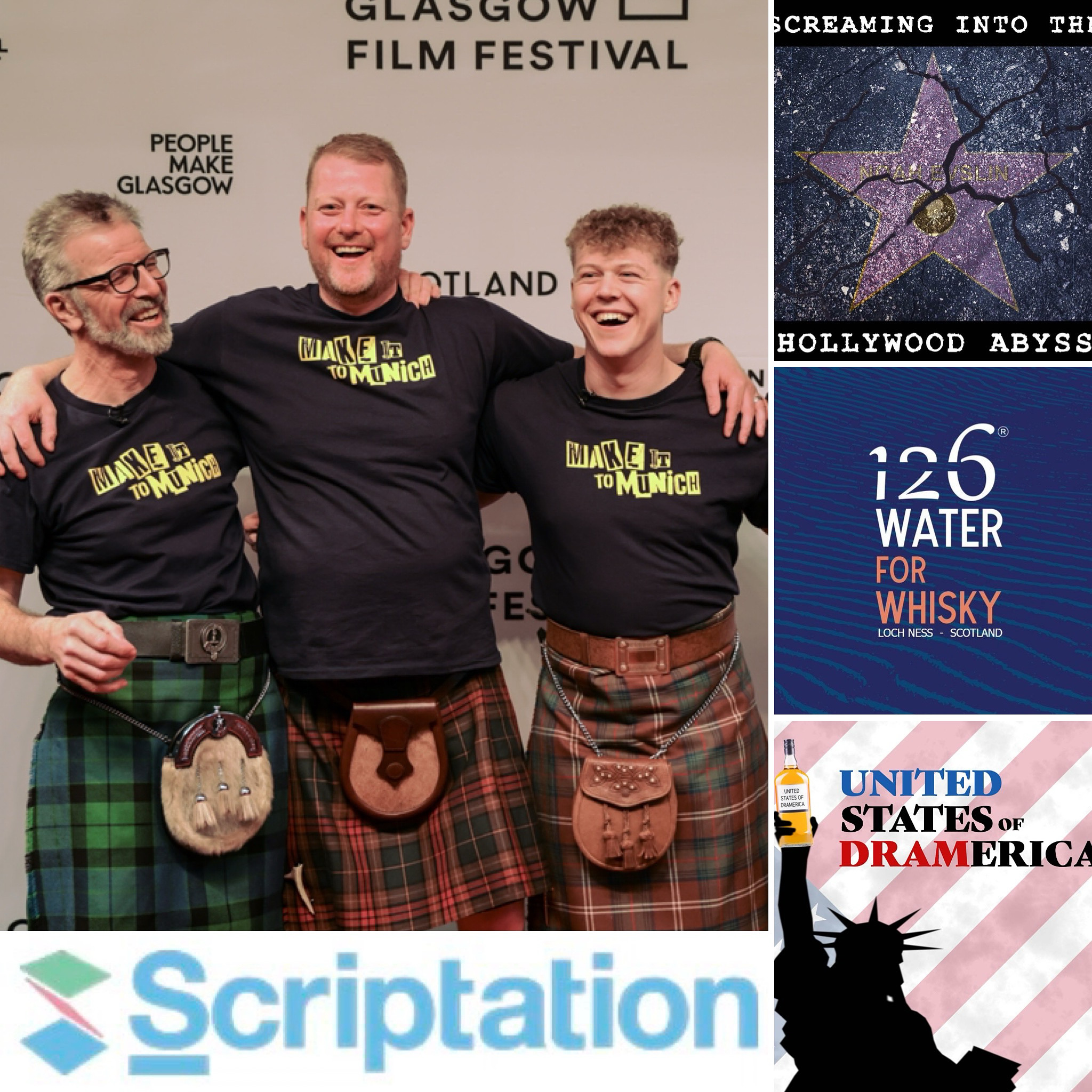
Take 147 - Special Episode. Martyn Robertson and Gordon Mackay. Make it to Munich.

 Apple Podcasts
 Spotify
 Podchaser
 RSS Feed
 We talk to filmmaker Martyn Robertson and sports surgeon Gordon Mackay about the inspiring feature doc Make it to Munich.
In a crossover episode we talk Hollywood and whisky, pioneering surgeries and telling stories with heart.
They explain how the extraordinary story of a young man’s courage to overcome life-changing injuries has ended up at the Chinese Theatre in Hollywood - the adventures they had along the way and the importance of real life heroes.
Any of us who've been in it for long enough, our entire career has been littered with jobs that we didn't get, projects that we thought were gonna go for sure. Dozens of unproduced scripts literally.
SPEAKER_02All of us running into both major and minor failures in Hollywood every single day.
SPEAKER_01This is one of the only businesses I can think of where failure is one bitch.
SPEAKER_06As ever, I am Dan Rutstein, your non-entertainment co-host. Welcome back to a rare crossover episode of both Screaming Into the Hollywood Abyss and United States of Dramerica. It'll become very clear as we go through why we've done this, but we're we're drinking whiskey with some Scottish people who've made a movie that is coming to Hollywood. Um, so that's why we're doing it this way. So let's start. Welcome to the show. Um Gordon Mackay and Martin. Welcome to the show. Tell us about why it is you are coming to Hollywood this weekend.
SPEAKER_05Well, we're coming to Hollywood with a film called Make It to Munich. Make it to Munich is the uplifting story of a Scots teenager, Ethan Walker from Aberdeenshire, um, and his surgeon, Gordon Mackay, um, who basically fixed him up after he had a terrible accident in New York State uh almost precisely two years ago. Um, so he was uh an aspiring football footballer in Huntley in Aberdeenshire, and he won a football scholarship in the US. And it was a big dream of his to go and take part in this. He went over there. Um, and two two two weeks into his uh scholarship, he stepped out in the road, looked the wrong way, and was hit by a car at 60 miles an hour. Um, he was left with some serious injuries, including uh brain hemorrhages uh and severely uh damaged ligaments in his legs, amongst other other injuries. Um, and so the film um charts the sort of tail end of his recovery, um, the story of meeting Gordon Mackay, um, who will tell you about his amazing um innovation and his procedure that he's invented in Scotland that is really changing world sport. Um and that was used to fix that Ethan up. Um and when Ethan um found himself in recovery asking the question, when can I get back to football? Uh Gordon basically makes this uh outlandish suggestion that uh he focused on cycling with them from Hamden, uh which is the Scottish National Stadium, to Munich for the opening game of the Euros in 2024, um, to support his team and to carry the pennant that's exchanged between the two captains on the field. Um so yeah, the the film follows that journey. Um and it's probably best that Gordon explains a little bit more about the the procedure itself.
SPEAKER_06So just before Gordon does that, we should have a we should just do the whiskey part. And obviously, before that, I need to make a joke, which is you obviously did the right thing by making sure he got there for the opening game and not the first knockout round, because obviously there'll be no guarantees for Scotland. So Martin, what is in your uh what's in your what's in your glass, Martin?
SPEAKER_05I am drinking uh Highland Park Dragon Legend.
SPEAKER_06Oh yes.
SPEAKER_05It's a nice one. It's uh this is yeah, so for people that are looking on screen, this is this is it here.
SPEAKER_06Yeah, it's an excellent drum. They they definitely do dramatic bottles. Uh it seems entirely appropriate that somebody in the table industry would be drinking one of those.
SPEAKER_04Gordon, what's it what's in your it's it's a hard, it's a hard call, but uh I have got a soft spot for Cochon at the moment, which is a an irley malt. It's uh it was either that uh or a brucoladi. Uh the cocoa. That's it, actually. There it is, right there.
SPEAKER_06Yeah, the machiapas. I have a bottle of that next to me as well. Really? I love it. I love it. Very good. Um, and I am drinking, um, as I often do, I've got Alexander Murray here, and I've got uh a bottle of the Orange County Soccer Club official single malt whiskey, the first sports team in America to do their own single malt. Um, I might I might, if I can get hold of one, I might bring a bottle down to the uh to your premiere um and hand one over, maybe two, obviously, so you don't have to fight over it. Um, but um I am uh I'm drinking that, and as I have to, I am drinking it with my one two six water for whiskey from Loch Ness, um, which I haven't got in all of my whiskies because uh it's amazing and it makes it taste even better. So now, gentlemen, thank you very much for jumping on. Cheers.
SPEAKER_04Um, so I know you're you're just mentioned, Dan, about you saying you bringing a bottle. I I I hope I suspect you know about the tradition. Uh I uh my aunt from Isla used to say that the uh every week it was for only for men, every funeral, you see, that you brought a bottle and you drank a bottle. That was the tradition. So um maybe maybe we could really reinstate that tradition when you visit us.
SPEAKER_06Yeah, absolutely. Um, so I probably should have done this as a three-way crossover with my football podcast as well, given that you are a former Rangers player, Gordon. But tell us, or we're gonna go deeper into everyone's career in a minute, but just tell us about you know what you did, why you did it, and and how this idea of of sort of showing the recovery through this incredible journey came about.
SPEAKER_04Well, uh, you know, I as you mentioned, I have a background in football, I did take time out of medicine, I uh love soccer, I did uh, you know, uh and uh so I could relate to Ethan as a 17-year-old, an aspiring professional athlete, and then the tragedy of his injury. So we're really trying to manage that. And the one thing I could help with was we developed technology that allowed us to reconstruct his knee. He had dislocated his knee, which means all the ligaments are disrupted and the knees off-ended, which is not ideal for a professional footballer. So the we had to start somewhere. So we started on rebuilding his whole knee and using this internal bracing technology to do it. But he made an amazing recovery, but there were other limitations we had to work around. So uh the idea was to really focus his energy and keep him positive, but we realized we didn't really have to do that. He's such an inspiring young man that he was he had nothing but positivity during his recovery. And then the filming side was really Martin. Martin started out to capture his miraculous recovery and early rehabilitation, and then Martin was on the journey with us all the way to Munich, and remarkably he was able to film and cycle at the same time. Quite a talent, really. Just as well I wasn't drinking whiskey at the time.
SPEAKER_06So for for the Americans or or even just the British people whose geography isn't very good, how far is is the journey and how long did it take?
SPEAKER_05Well, we we we think we cycled in the end about 845 miles. Um we did that in nine days, Gordon?
SPEAKER_04Yeah, we we did. And uh we factored in a little we we liked to count it in kilometers, it always is more impressive. So actually it might be 1200 kilometers, but we reckon we cycled 1350 because our navigation was pretty pathetic, okay? And uh so that was roughly the distance, and and it was over 13 days. We had to factor in one or two rest days because we were broken basically. Uh, but that was a journey.
SPEAKER_06So Marty, just can you tell us the sort of the shortish version of your journey in entertainment? And then also as a sort of second point, I know documentaries have over the last few years have become a lot more mainstream, as it were, and they've they've turned more into movies than perhaps they were in the old days. Just tell us sort of say how you got into the business, as it were, um, and then what inspired when when you how you heard about this story and then the desire to try and make it.
SPEAKER_05Yeah, so I trained as an actor originally. Um I went to drama school. Um, and but in my final year at drama school, I specialized in directing. And I decided quite quickly once I graduated that I what I found difficult is sitting waiting for the phone to ring. Um, you know, actors typically need agents to give them their give them a call and give them a job. I just wasn't very good at that. So I I was I was much more interested in making stuff happen myself and making making things happen quickly. So I moved into directing and producing um in theater initially and then moved into film. Um, and I suppose I kind of fast forward maybe 10 years, and I had set my own production company up, a commercial video production company that um allowed us to speculate on some of our own work um in the independent film world. So we have two companies we have Urban Croft Films that does commercial video production services across the UK, and we have a company called Blackhouse Films, which basically is our own stuff, it's our own ideas, or it's collaborating with other people and companies. And in terms of experience from there, bunch of short films, both in drama and docs. Um, and then this is my third feature dock. Um, so I made a my first feature doc, which was a doc in LA actually, um, about uh a Scotsman who um landed apart playing Tom Hanks' Irish brother in a Warner Brothers movie, um, which was premiering at the Chinese theatre, ironically. Um, and he will he basically came back to Scotland after filming and said, Oh, you know, a really you know amazing time filming with all these stars. And we asked him if he was going to go to his premiere, and he said, No, I can't afford it. Um, too skin after it. So my friend and I made a pack to get him there. So the film it follows us trying to get him to his premiere uh in the red carpet at the Chinese theatre, uh, which is mad because we're now looking at a premiere on Sunday at the Chinese theatre with this film. So I've sat in that theatre um with Tom Hanks, uh, and now I'm gonna be sitting with Gordon Mackay. So he didn't disappoint you. But if you don't help you though, so that's where it began, and then I made a film uh around six or seven years ago called Ride the Wave, which basically follows the emergence of a very young uh Scottish surfer. You don't see many uh big wave surfers in Scotland, and this young boy, we followed him from the age of 12. Um, and he surfed some of the biggest waves in the world uh by the time he was 15. Uh, that boy is now fully signed with Red Bull. He's doing really well, he's got an amazing career ahead of him. Um so we made a film called Ride the Wave. And then, you know, I had been working uh making content around Gordon's invention, essentially, uh, for uh I mean nine, 10 years we've been working together um trying to basically articulate what it what the benefits of it were. Um we were making case studies, many documentaries, adverts, and things. And so we we had a relationship uh already. We're also trying to make a film in India about something slightly different. And we were on a plane going to India, and Gordon told me about Ethan Walker and this amazing story, and that's where it really began. And when we got back from India, I went and met Ethan and his family, and we started filming. And we thought, wow, this is an amazing story. And it just grew arms and legs. And you know, you talk about one of your podcasts being about how difficult it is to get content made. This is a difficult film to get made because it was right in front of us with no time, and it had to be made there, and then there was no time to go and seek commissioners or financiers at that point. We just had to go and embrace it as a adventure, and it's almost like how we're about to embrace Hollywood. You know, we're coming out in the next few days in exactly the same way with exactly the same spirit that we embarked on the journey to Munich with. So yeah, it's good.
SPEAKER_06I mean, it's a great story. I guess obviously it's good that you've been to the Chinese Theatre. So you you know what it is in the sense of you know, it's as iconic as you get. Um, I think obviously I'm gonna be coming to your premiere on Sunday. Um, I think last time I was there was for the Wallace and Gromit premiere. Um but the um you know it's a it's a really special place. How does one make um at least what from the outset in America feels like a niche documentary about some adversity and some cycling and some football in a tournament that probably passed a lot of Americans by? How did you manage to get to the point of having it premiere in such a vaunted location?
SPEAKER_05Well, the festival director Peter Green um and I had screened my first film uh in one of his other festivals at Marina Del Rey. Um, and it had actually won best uh feature doc at that festival. And so I dropped him an email saying, Look, I made this film, uh, it's a crazy, it's another crazy Scottish story. Um interested question mark. And he came back and said, I'm really sorry, the festival we're the the program's full, we can't do anymore. Um we just you've come too late to me. And then a month or two later, he came back to me and he phoned and said, Look, we're doing this other festival, um, and it's at the Chinese theater, and it's a great opportunity for you to do your premiere there, maybe attract some um distributors um and seek some uh American distribution on the story. And and he he was very much of the opinion that American audiences would really love this story because you know it's Scottish, it's it's essentially a story about friendship and resilience. Um but it's got loads of heart, you know. It's not just about football, it's not about cycling, it's it's much more than that. And I think it'll really go down with US audiences.
SPEAKER_06And if it doesn't, at least you guys turning up on the red carpet in your kilts should attract some attention from the media. We'll definitely have fun.
SPEAKER_04There's no doubt about that. First and foremost, we're coming to LA to enjoy ourselves. This is going to be a successful trip, regardless.
SPEAKER_06The the cycling part of it, the the journey, so obviously he's recovering from terrible injuries with your innovative support. Where did the the sort of the cycling and then the cycling part sort of come from? And also how did you manage it with the I assume it's the real pennant, and therefore how did that all get organized with the SFA?
SPEAKER_05You want to talk about the cycling bit, Gordon?
SPEAKER_04Well, yeah, the cycling cycling, we had been knocking around ideas, Martin and myself, and he martin had been uh first so deceived that he had he at the back of his mind thought this would be tremendous. He had uh I had a a friend who sadly had passed away, but in in his memory, he was saying, I would love to do something, or maybe like cycling all the way to Munich. So when I had that horribly uncomfortable moment with Ethan yet again, where I see a young man recovering and then getting so excited about the prospect of being able to play soccer again, and and instead of deflating him, I really wanted something we could aim for together. And it was a no-brainer. It was immediately that that that idea of cycling to Munich. At that time, in fairness, we didn't know whether Ethan had the balance to ride a bike, we had no idea whether his mother would even let him on a main road with the bike after being hit by a car. There were a few practical thoughts, but immediately Ethan lit up, and it was fantastic to map his recovery because I Martin talked a wee bit about the injuries, but if you don't mind me just as uh with my medical hat on, these were life-threatening injuries. His parents were called to New York and he spent two weeks in intensive care on the understanding he wasn't going to survive. So that's where we started from. He had subarachinoid hemorrhage, skull fracture, scapular fracture, wrist fracture, pelvic fracture, timbal fracture, knee dislocation, to mention a few. And this young boy cycled all the way to Munich to support his team nine months after this event. It's truly remarkable. I mean, it it it might seem like a uh you know a strange topic for a m for a film, but it it is one of the most it's the most remarkable story from the the whole of the European competition. In fact, it probably should be the story for the World Cup when it comes to Canada, US, and Mexico. Because the we you no other sportsman who's going through injury will find anyone that inspires them more than young Ethan Walker. It's a brilliant story.
SPEAKER_06I mean, how I know plenty, well, you know more than me, but I know plenty of sportsmen who've have injuries and the ends their career or they have to fight to overcome it. I mean, you you will have dealt with a lot of different patients with varying levels of injuries. What was it about Ethan where both you knew that you could help him, obviously medically, but also you like when did you first realize that he was special and there was something really important that you could do with him?
SPEAKER_04Well, when I first met him, I didn't even realize he was for my clinic. He looked so emaciated. He had a feeding tube, he couldn't swallow, his speech was impaired, and he was wasted and uh resting and uh again assisted from a chair. And uh when I realized it was my patient, it was just heartbreaking to see his mother desperate to find anything that could help or facilitate his recovery. And I knew I could at least get him back on his feet. So that was my original project with Ethan. But then you realised uh it just touches you. I I actually think anybody that goes to watch the movie in the US will be touched by Ethan and they'll want to adopt him. Is uh it's just I mean, every if I deal with an athlete who's seriously injured, generally speaking, they get depressed and withdrawn to start with because that they they they they feel they're removed from their team. If they can't go back to sport, it's like bereavement. You'll have to bring the family in, their whole life's turned upside down. Well, Ethan knew how serious his injury was, but he didn't ever complain. And I and it reflected in all of us. We all just want to do our very best for this young man that was setting such an example to us all of how you can deal with adversity, and it was just fortuitous, it overlapped with technology because the procedure Ethan had in his knee would normally be, say, four procedures in the US, it was standard, still standard proceed approach. There might be several operations over say two years, uh, who would have an extended period of disability after each? So this approach things very differently. And in fact, we had Ethan jogging 12 weeks after uh the massive surgery.
SPEAKER_06Um changing tack a little. Martin, why is why are documentaries becoming much more mainstream, I think, than they they were in the past? What what is you know, is it a societal thing? Is it just the the quality of what people are making? It it feels like and I I don't know where the line was, but when I was younger, I don't documentaries were much more niche, and I don't know if it's Netflix, but they seem to be everywhere and and watched like normal feature films to an extent now.
SPEAKER_05Yeah, absolutely. And I think that's the trick, isn't it? It's um it's essentially instead of them being purely seen as informational films, they've become, you know, a narrative feature doc, you know, f is every bit as cinematic and as cinematic and an experience as a drama, uh a theatrical drama. So I think, and I think the streamers have helped that to an extent. But I also think that people are looking for something different. People like the real story. People like listening and watching stories about real things and real happenings and real, real characters. We're saturated by the blockbuster, you guys especially. And so I think, you know, there's a there's a real exciting space opened up for documentary now. And it's it's big business, you know, when you get to that level. So they can compete. Um it's difficult to get them away. There's obviously still a huge amount of competition. Um but, you know, I suppose with this film, um, it's a story full of heart. You know, it's a film that's you know, cinematically, it's filmed by me on a bite with one hand. So it's never going to win awards for its cinematic capabilities, but it's got heart and it's uh it's authentic. Um, and people really connect with it. And that's what we've noticed about audiences and the reaction that we've had. We had our TV premiere this week on the BBC here. Um, and the reaction that we're getting on social media is is immense. Um, people are really emotional when they watch it. Um, and I think you know, it's a kind of mixture of feeling for Ethan, but there's also a joy in watching the success that we have making it to Munich. So yeah, I mean, listen, I'm a big fan of docs. And actually, having trained in in theater originally um and really specialized in drama, I got to a point in my own career where I stopped connecting to acting uh and script work. I I was watching stuff and I just thought I'm not really engaged by this anymore. I'm much more interested in the ability to capture a moment that can never be captured again, you know, the in the same way. And that's just completely compelling for me. That idea that that's the power of documentary is that, you know, in that moment, at that time with that camera, you can get something that is completely unachievable again. Um, so yeah, I mean, that's why I'm excited about it, and that's that's why I focus on feature docs.
SPEAKER_06And in terms of sort of where things are now with Ethan, obviously this has happened when this happened, you know, at the tournament. Um, obviously the the documentary's come out. Like, what what's he doing now? Um and how is this help you know helping him with what he's doing now?
SPEAKER_04Well, we run the risk of a bit of a spoiler if anyone wants to go to the next game, but uh the the item is thriving. I think it's really helped to rediscover himself uh as a young man moving forward. Uh there are opportunities for him now. Uh he's involved in coaching, he's doing uh studies in terms of sports management uh and so forth. And there might be another niche, although he still has a passion to return to uh play competitively. So it's it's managing expectation is the challenge here, because he is such a strapping fit young man now, but uh he's done tremendously well, and I hope this again opens other opportunities for him. But um it's uh yeah, he's doing very well.
SPEAKER_05That's just I think the the the other thing is that the we've been on tour with this film doing a roadshow. Um we've had the privilege of taking the film to cinemas large and small all all over the country here in the UK. And what's been lovely about that is we've been joined by former professional footballers who have come and talked about injury as part of the Q ⁇ A's after the after the film. Um and that's been a really lovely experience for Ethan because he's he's had the opportunity to meet other people that have had similar experiences and they've bounced back, um, or they've changed tact and developed coaching careers or other things. Um, so I think that the opportunity to go and talk about his experience with audiences has been great for him and great for the audiences. I know that some of the comments we've been getting from young people who have uh connected with Ethan are so positive and inspiring. Um that yeah, he's really developed his own ability to communicate the experience he's had, and I think that'll really stand him in great stead for the future as well.
SPEAKER_06So, one thing I was going to ask is obviously, you know, obviously the the Scottish Football Association must have been involved for the for the pennant to be involved. Like that in terms of the interaction with the SFA, with with the team, um, you know, with footballers who obviously made, I mean, made it to the Scottish national team, but still, you know, you could describe that as making it. Um, but you know, how have they been with with him?
SPEAKER_05Well, like everybody along the journey, uh, the SFA were touched by the story and they were moved by the material that we put out really early on as we were making the film, uh, the little teasers and the little pieces of content that we put out there just to raise profile. The media in Scotland have been amazing with this story. It's captured the hearts and minds of such a wide range of media from you know the very kind of top level of BBC breakfast for 21 minutes to local rags everywhere doing constant kind of coverage on it. So it was a really popular story. And so when it arrived on the desk of the SFA, the SFA backed the project, got right behind it from the top down. And it was suggested that Ethan should carry the pennant, um, which is essentially a little flag that's exchanged between the two captains before the game. And so at Hamden, when we were leaving, uh Aston Villa captain uh John McGinn, who's also the vice captain of Scotland, handed it over to Ethan. Um, and when we got to to Germany, uh it was handed over to the captain, Andy Robertson, uh Liverpool player. So so yeah, I mean it's it's sort of captured the hearts and minds of of all sorts of folk in all sorts of walks of life. So yeah, it's been great. Magnificent.
SPEAKER_06Just as an aside, Coran, I know we talked off camera about the fact that you played for the mighty reigns. Just can you just tell us a little bit about your your sort of your your fledgling football career, the conversation you had with the manager, which sort of ended the career but turned turned you on to you know doing the medicine more professionally and the whole sort of concept of sports medicine and how it can transform lives.
SPEAKER_04Yeah, I think uh I I mean I started I was almost passionate about my football, and um I I I had a hard decision to make at times between what to focus on, a mother that was a doctor, a father had been a professional player, and I focused on what seemed to be the sensible option. But as a young man, I thought I really want to find out if I could be a professional player before I'm too old. So I waited, I waited till my ticket was stamped as a doctor, and I immediately took time out to play professional football. I was fortunate enough to get invited to Ibrooks uh when Walter Smith was uh sorry, Graeme Soonis was the manager, and Walter Smith was the assistant manager in season 88-89. And it was a wash with English players, wash with English players. But no, the great thing was that they were all international standard players. So much as they did their best to keep me out of the team, they it it was a privilege to be there, and I learned a lot. By the end of the season, as I explained, the management team, Soonis and uh Walter Smith took me aside and asked if I was really a doctor. I said, Well, I am actually, and they said, Well, how about it, Doc? Come on, and uh, how about combining this with sport? So that's where I started my sports surgery career, and I've been focused on sports surgery and sports medicine ever since. Although at that time in Scotland it was considered laughable to do that. They thought sports medicine meant a magic sponge, some cold water, and you just splashed it on every ache and pain, and that was the extent of it. So, but that's where the journey started.
SPEAKER_06Amazing. And obviously, you know, you've I think you said you've you're working, you know, you've got this innovative treatment, you are working with doctors in in this country. Um how much how much is about professional athletes and I either you know giving them a chance to extend their careers or save their careers, and how much is it is what they call over here weekend warriors, but in terms of just your casual sports, you know, casual professionals who happen to be playing sport and being able to give them a chance to continue a passion. Um and what the similarities and differences?
SPEAKER_04I well, to answer you honestly, I get as much satisfaction from the weekend warrior as I do from an elite athlete now. I I don't I don't have quite the same stary-eyed approach, and I guess having been involved uh and that close to it, you see it from a different perspective. But the idea of you know sports so important to people and their lifestyle, whether it's physical or mental health, I love being able to help people get back to what they enjoy, and uh it's just as satisfying as I say, at grassroots level. At the more elite level, it comes with its own challenges. Fortunately, an involvement in professional sport gave me some insight, agents, all these other issues, money. So it's not always as it seems, and uh so it's more challenging. But that time out in professional sport was a fantastic apprenticeship. It prepared me to move in that area. The reality is though, if you're researching and you want to improve the care for patients generally, if you can suggest a potential advantage to elite sport, then the research gets progressives at 100 miles an hour. So, for example, with the internal brace which I developed, uh there are over a million patients now with internal brace, I believe, in North America, which is very satisfying, including those in elite sport. But what you find is it might get your uh soccer player or your American footballer back in half the time, it might reduce the reinjury rate by five or even tenfold, but it's just as good in your diabetic, your obese patient, your elderly patient who can't mobilize. If you can give them a small procedure that gives them a massive return, it's far more satisfying. So um, so yeah, we're led by the aspiration to improve the support to elite sport, but the real satisfaction comes in rolling it out to the weekend border.
SPEAKER_06That's a great answer. Is there is that given given the impact that you've had on so many lives, is there any part of you that wishes you'd been 5% better and you could have made it as a footballer? Or are you are you pleased that you've ended up with the career that you've had?
SPEAKER_04I I am well, I love my career. I do enjoy it's business and pleasure. Uh no, it was very hard at the time, I would say, to accept that it wasn't injury or more lack of ability that pointed me in this direction. But uh I wouldn't change anything. I'm very grateful for that bit of tough love from Graham Soonis and Walter Smith.
SPEAKER_06Yeah, Graham Soonis has given tough love and tough non-love to plenty of people. Very good. Have you seen have you come across him since and thanked him for his advice?
SPEAKER_04Uh well, I've never thanked him that directly. I have indeed come across him since we have met up at charity events and and and and games and so forth. And uh so it's nice to keep in touch with these guys. Uh no, I tend not to bring that up uh specifically, but he'll remember it well.
SPEAKER_06Yeah, sure. Very good. So, Martin, back back to you in terms of of where you are. So I guess this is a question for sort of probably for our for our Hollywood audience, as it were, because obviously a lot of them are traditional writers, but other we've had other people on here who either work in reality TV or who have done documentaries as well. What what does this look like for you in terms of how do you measure success with something like this? Obviously, there's there's commercial success in terms of distribution, but also in terms of what you're what you're hoping to achieve through this documentary and and what it means for your ability to maybe do more of this sort of storytelling in the future.
SPEAKER_05Well, do you know what? I think that with this film, we measure success on the impact that it has on the audience and the feedback we get from them based on what they take from Ethan's story and Ethan's journey. And largely that's relating to one of the first lines in the film, without you know too much of a spoiler. And Ethan's sitting at the side of the road, and he he basically says, Um, I want people to realize that if they want to do something, they can just do it. Anything is possible. Um, and that became very quickly became the kind of mantra for the whole project. Um, both the making of the film, the can the filmmaker make it to Munich as well as the team, you know, uh, from a fitness point of view. But but also can we can we go on a journey together whereby we make something that's special that talks a lot uh talks about male friendship and and and a bond that's a kind of unusual bond between four brothers that are from quite different walks of life? Uh, and can we then you know finish that film and take it on a journey to audiences that will really resonate with it? Um, and so I measure success on the conversations I have in the bar afterwards with people, the unlikely people that found themselves buying a ticket by accident and really being moved by the story. Um, that's success for me, you know. Um, the conversations that I see Ethan having with other young people in the audience that were dragged along by their parents but actually really wanted to connect with him. You know, the amount of messages that Ethan gets privately from people on his Instagram and stuff after after screenings, you know, that that's success for me. Um definitely with this film.
SPEAKER_06Magnificent. Look, I know you gentlemen have actually got a flight to catch soon. Um, so I'm I'm gonna wrap up and I'm gonna I'm gonna do the final question for each of the two podcasts separately. I'm gonna ask you, Martin, the Hollywood one, and you Gordon, the whiskey one. Um so I'll start with I'll start with you, Gordon. Um if you could drink any whiskey with anyone, dead or alive, what would it be, who would it be, and where would it be? Wow.
SPEAKER_04Um I think that's very hard to answer. But I would say I I would say I would think probably the well, maybe varying the the drink a little actually. Uh so maybe maybe a balvany, and I would choose to drink it with uh Sir Alex Ferguson, I think would be excellent company uh for me, but uh alternatively top Hollywood airlister at the Chinese theatre, that would be an enjoyable evening. I mean I would I would think a few whiskies in that company, uh it would give Ethan a tremendous lodge.
SPEAKER_06Very good. Um Martin, um if you could give a single piece of advice to somebody wanting to enter the the business, in your case on the sort of documentary side, what would that single piece of advice be?
SPEAKER_05Never accept no for an answer.
SPEAKER_06That's great. That's great.
SPEAKER_05As simple as that. Um last time I was there. That's what Ellie taught me.
SPEAKER_04I can testify to Martin's resilience. Unbelievable how we uh this has taken this there's the the whole project from musical scores, the details of the cinematography, the the improvising, endless improvising to be honest. Uh, and then to get a final result and to end up in such a location. I think it's truly remarkable. I've just been observing this journey, it's amazing.
SPEAKER_06Fantastic. Look, uh Martin Robertson, Gordon Mackay. Uh thank you very much for joining me at relatively short notice, uh, but worth doing because it's such an inspiring story. Um, safe travels. I look forward to seeing you at the Chinese theatre this weekend um and seeing this documentary or feature doc um and seeing what it's all about in terms of the heart, the storytelling, all of that stuff. So thank you very much indeed for your time. Thanks, Dan. See you soon. Pleasure.
SPEAKER_03Thank you so much for listening, and thank you in the music. As always, each episode is notation. My favorite screen reading annotations. If you want to support the show, please tell them to copy at www.tation.